English
 Español
 tiếng việt
 русский
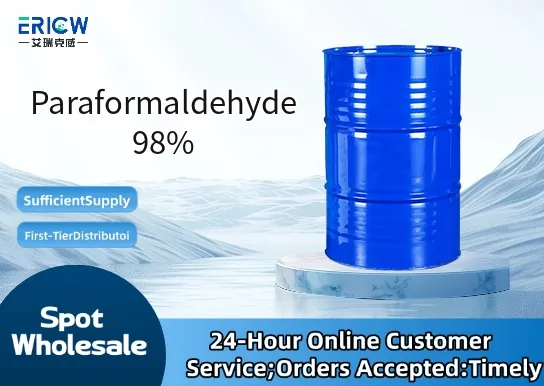
High-purity solid polymer of formaldehyde with ≥98% assay, ensuring consistent reactivity and minimal volatile formaldehyde emissions during handling.
Low moisture content (<0.5%), enhancing storage stability and reducing premature depolymerization.
Fine, free-flowing white powder morphology for uniform dispersion and precise dosing in industrial formulations.
Controlled molecular weight distribution (average degree of polymerization: 25–45), optimizing solubility and thermal decomposition profile.
Manufactured under strict ISO 9001-certified processes with batch traceability and full analytical COA documentation.
Synthesis of thermosetting resins including phenol-formaldehyde, urea-formaldehyde, and melamine-formaldehyde binders for wood composites and foundry sands.
Chemical intermediate in pharmaceutical manufacturing for controlled-release prodrugs and crosslinking agents.
Disinfectant and fixative agent in veterinary and laboratory settings, especially where liquid formalin is impractical or regulated.
Production of specialty agrochemicals, including slow-release nitrogen fertilizers and pesticide stabilizers.
Surface modification of textiles and paper to impart wrinkle resistance, wet strength, and antimicrobial properties.
| Chemical Type | Linear polyoxymethylene polymer (formaldehyde polymer) |
| Product Form | Free-flowing white crystalline powder |
| Appearance | White to off-white granular or powdered solid |
| Melting Point (Decomposition) | 120–170 °C (endothermic decomposition with formaldehyde release) |
| Assay (as CH₂O) | ≥98.0% (by titration, per ASTM D1977) |
| Moisture Content | ≤0.5% (by Karl Fischer method) |
| Volatile Matter (105 °C, 2 h) | ≤1.0% w/w |
| Residue on Ignition | ≤0.1% w/w |
| Common Compatible Systems | Suitability |
| Phenolic resin synthesis systems (alkaline catalysis) | Highly Recommended – Excellent solubility in hot aqueous alkali; yields high-strength resol resins with low free formaldehyde. |
| Aqueous acid-catalyzed urea-formaldehyde prepolymer reactors | Recommended – Requires controlled heating ramp to ensure complete depolymerization; compatible with standard UF process parameters. |
| Thermoplastic polymer masterbatch extrusion (e.g., PP, PE) | Suitable – Can be incorporated as a formaldehyde donor for in-situ crosslinking at elevated melt temperatures (>160 °C). |
| Aqueous disinfection tank systems (with controlled pH/temperature activation) | Recommended – Effective upon thermal or acidic hydrolysis; requires monitoring of formaldehyde vapor concentration per OSHA PEL guidelines. |
Q1: What is the CAS Number for Paraformaldehyde 98%?
A: The CAS Registry Number is 30525-89-4 (for polymeric formaldehyde, general designation); note that paraformaldehyde is not assigned a single unique CAS due to variable chain length, but this number is accepted globally for technical-grade material.
Q2: How does Paraformaldehyde 98% compare to 37% aqueous formalin in terms of formaldehyde delivery efficiency?
A: Paraformaldehyde delivers ~92 wt% theoretical formaldehyde (vs. 37% in formalin), with significantly lower water content and no methanol stabilizer—reducing side reactions, improving resin solids content, and minimizing drying energy in adhesive applications.
Q3: Is Paraformaldehyde 98% compliant with REACH and FDA 21 CFR requirements for indirect food contact applications?
A: Yes—this grade meets REACH registration requirements (ECHA dossier available) and complies with FDA 21 CFR §177.1350 for use in phenolic resins intended for repeated-use food-contact surfaces (e.g., laminated countertops), subject to end-product migration testing per FCN guidelines.
Q4: What is the expected formaldehyde migration level from cured Paraformaldehyde-based resins under typical service conditions?
A: Fully cured phenol-formaldehyde resins derived from Paraformaldehyde 98% typically exhibit <0.1 mg/dm² formaldehyde migration in EN 13130-1:2021 testing at 40 °C/30 days, well below EU limit of 15 mg/kg for food-contact articles.
Contact With Us:
E-mail: wangxingqiang@ericwchem.com
Have a Questions? Call Us:
Add:
Building A1, Jiete Industrial Park, Huangpu District, Guangzhou City, Guangdong Province, China