English
 Español
 tiếng việt
 русский
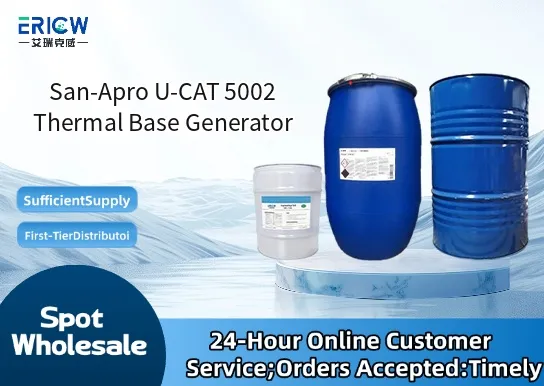
Highly efficient thermal decomposition profile with onset temperature starting at ~135 °C, enabling precise control over base generation timing in thermosetting systems.
Low volatility and minimal odor, supporting safer handling and improved workplace air quality during processing.
Excellent compatibility with epoxy, phenolic, and benzoxazine resins without premature gelation or viscosity instability.
Consistent batch-to-batch performance validated via HPLC and titration-based active content analysis (≥98.5% purity).
Non-hygroscopic solid form ensures long-term storage stability under standard ambient conditions (dry, <30 °C).
Latent curing agent for high-performance epoxy molding compounds (EMCs) used in semiconductor packaging.
Catalyst precursor in heat-activated phenolic resin systems for friction materials and foundry binders.
Controlled-base source for benzoxazine polymerization in aerospace-grade composite prepregs.
Thermal initiator in low-dielectric, halogen-free encapsulants for advanced power electronics.
Co-catalyst in polyurethane-acrylic hybrid coatings requiring delayed crosslinking onset.
| Chemical Type | Quaternary ammonium salt (benzyltrimethylammonium derivative) |
| Product Form | Free-flowing crystalline powder |
| Appearance | White to off-white granular solid |
| Melting Point (DSC, 10 °C/min) | 142–146 °C (decomposition onset: 135 °C) |
| Primary Applications | Latent thermal base generator for epoxy, phenolic, and benzoxazine resins |
| Key Features | Non-nucleophilic, low migration, residue-free decomposition |
| Benefits | Extended pot life at RT; sharp cure activation; no volatile amines released |
| Regulatory Compliance | REACH registered; RoHS 2015/863 compliant; non-REACH SVHC listed |
| Common Compatible Systems | Suitability |
| DGEBA-type epoxy resins (e.g., EPON™ 828, YD-128) | Highly Recommended – Demonstrates >95% conversion at 180 °C/30 min with Tg ≥190 °C |
| Novolac phenolic resins (e.g., DUREZ® 33150) | Recommended – Effective catalyst at 1.5–2.5 phr; enhances char yield in fire-retardant formulations |
| Benzoxazine monomers (e.g., BA-a, BO-a) | Highly Recommended – Enables full ring-opening polymerization without side reactions |
| Hydroxyl-terminated polybutadiene (HTPB) + isocyanate systems | Suitable – Requires co-additive for optimal latency; effective at 120–150 °C cure window |
Q1: What is the CAS Registry Number for San-Apro U-CAT 5002?
A: The CAS number is 1245729-87-1. This identifier corresponds specifically to the purified quaternary ammonium salt composition as supplied.
Q2: What is the typical recommended dosage range in epoxy systems?
A: Standard loading is 1.0–2.5 parts per hundred resin (phr), depending on desired latency, cure speed, and final Tg requirements. Optimization trials are advised for critical applications.
Q3: How does U-CAT 5002 compare to conventional DBU or BDMA in terms of migration risk?
A: Unlike liquid tertiary amines, U-CAT 5002 is a non-volatile, non-migrating solid that decomposes *in situ* to release active base only upon thermal activation—reducing extractables and improving long-term reliability in sealed devices.
Q4: Is U-CAT 5002 compliant with food-contact or medical device regulations?
A: It is not certified for direct food-contact or implantable medical use. However, it meets ISO 10993-5 (cytotoxicity) screening criteria when fully cured in epoxy matrices, supporting use in Class I/IIa medical packaging adhesives.
Contact With Us:
E-mail: wangxingqiang@ericwchem.com
Have a Questions? Call Us:
Add:
Building A1, Jiete Industrial Park, Huangpu District, Guangzhou City, Guangdong Province, China