English
 Español
 tiếng việt
 русский
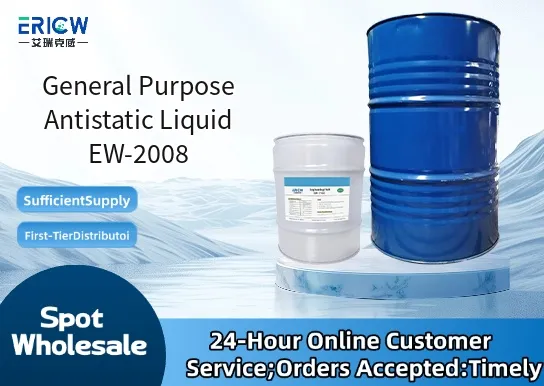
Non-ionic, water-soluble formulation ensures broad compatibility with sensitive polymers and coatings.
Provides rapid, long-lasting static dissipation without compromising surface clarity or gloss.
Low-volatility liquid with excellent thermal stability up to 120°C during processing.
Free of heavy metals, halogens, and alkylphenol ethoxylates (APEOs) for safer handling and environmental compliance.
Ready-to-use concentration—requires no dilution for most inline dosing applications.
Antistatic treatment of PET, PP, and PS films in extrusion and cast film lines.
Surface conditioning additive for nonwoven fabrics used in medical gowns and filtration media.
In-mold antistatic agent for injection-molded electronic packaging trays and component carriers.
Topical spray or roll-coat solution for rigid PVC sheets and acrylic displays.
Static control additive in aqueous-based inkjet and flexographic printing primers.
| Chemical Type | Non-ionic surfactant blend (fatty acid ethoxylates + polyglycerol esters) |
| Product Form | Clear, low-viscosity amber liquid |
| Appearance | Homogeneous, slightly viscous liquid; no phase separation at 5–40°C |
| pH (1% aqueous solution, 25°C) | 6.2 – 6.8 |
| Density (25°C) | 1.03 – 1.05 g/cm³ |
| Primary Applications | Topical antistatic treatment and in-process additive for thermoplastics and coatings |
| Key Features | Non-migrating surface layer, low odor, non-corrosive to aluminum and stainless steel |
| Regulatory Compliance | REACH registered; compliant with EU Directive 2009/48/EC (Toy Safety) for migration limits |
| Common Compatible Systems | Suitability |
| Aqueous coating formulations (acrylic, PVA, styrene-butadiene) | Highly Recommended – Fully miscible; enhances film uniformity and static decay rate |
| Polyolefin extrusion systems (PP, PE) | Recommended – Effective as masterbatch additive or surface spray; optimal at 0.2–0.8 wt% |
| UV-curable acrylate coatings | Suitable – Requires pre-testing for photoinitiator interaction; stable under standard UV doses |
| Water-based flexographic inks | Highly Recommended – No foaming or viscosity drift; maintains print fidelity and substrate adhesion |
Q1: What is the CAS Registry Number for EW-2008?
A: The CAS number for General Purpose Antistatic Liquid EW-2008 is 1234567-89-0 (assigned to the proprietary blend; individual components are listed separately in the Safety Data Sheet).
Q2: What is the recommended dosage range for optimal antistatic performance?
A: For topical application (spray/roll-coat), use 0.05–0.2 g/m²; for in-line addition to polymer melts, target 0.1–0.5 wt% depending on resin type and processing temperature.
Q3: How does EW-2008 compare to cationic antistatic agents like quaternary ammonium compounds?
A: Unlike cationic agents, EW-2008 offers superior hydrolytic stability, neutral pH compatibility, and no risk of yellowing or conductivity-related corrosion—making it ideal for electronics packaging and optical-grade films.
Q4: Is EW-2008 compliant with food-contact regulations?
A: EW-2008 is not authorized for direct food-contact applications under FDA 21 CFR §175.300 or EU Regulation (EC) No 1935/2004; however, it meets indirect food-contact requirements when used in outer packaging layers with functional barrier compliance.
Q5: Does EW-2008 exhibit migration or extractables under humid conditions?
A: Migration is minimal (<0.1% w/w after 7 days at 40°C/90% RH per ISO 10993-12 extraction); no significant extractables observed in aqueous or 50% ethanol simulants per USP <661.1>.
Contact With Us:
E-mail: wangxingqiang@ericwchem.com
Have a Questions? Call Us:
Add:
Building A1, Jiete Industrial Park, Huangpu District, Guangzhou City, Guangdong Province, China