English
 Español
 tiếng việt
 русский
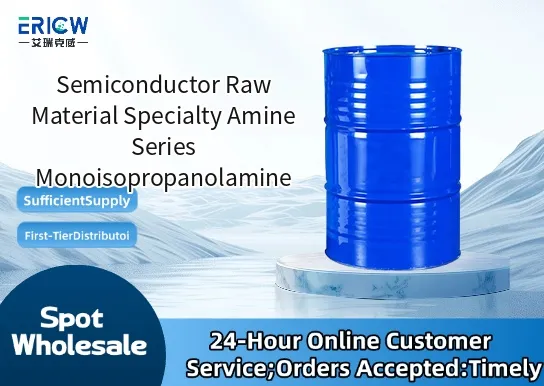
Ultra-high purity (≥99.95%) with stringent metal ion control (Na, K, Ca, Fe, Cu < 10 ppb) for semiconductor-grade process compatibility.
Low volatility and controlled vapor pressure ideal for cleanroom-compatible chemical delivery systems (CDS) and vapor-phase deposition precursors.
Exceptional hydrolytic stability and thermal robustness up to 180 °C, ensuring consistent performance in high-temperature wafer cleaning and etch-resist formulations.
Engineered low residual moisture (<50 ppm) and minimal aldehyde impurities (<1 ppm), reducing risk of particle generation or film defects.
Non-corrosive to stainless steel (316L) and fluoropolymer (PFA, ETFE) wetted materials, supporting long-term system integrity in ultrapure fluid handling.
Advanced photoresist strippers and post-etch residue removers for 7 nm and sub-5 nm logic/foundry nodes.
Stabilizing ligand in metal-organic precursors for atomic layer deposition (ALD) of high-k dielectrics (e.g., HfO₂, ZrO₂).
Co-solvent and pH buffer in ultra-low surface tension CMP slurries for copper and low-k dielectric polishing.
Complexing agent in electroless plating baths for selective barrier layer formation (e.g., CoWP, NiB).
Functional additive in spin-on carbon hardmask (SOC) formulations to enhance etch selectivity and pattern fidelity.
| Chemical Type | Secondary alkanolamine |
| Product Form | Liquid (clear, colorless) |
| Appearance | Clear, water-white liquid; no visible particulates or haze |
| Melting Point | −10 °C to −7 °C |
| Boiling Point (760 mmHg) | 165 °C–168 °C |
| Primary Applications | Semiconductor wet processing, ALD/CVD precursor stabilization, CMP chemistry, photoresist engineering |
| Key Features | High purity, low metals, low moisture, low volatility, non-corrosive |
| Regulatory Compliance | REACH registered; RoHS 2 compliant; meets SEMI C12:2020 purity classification for electronic chemicals |
| Common Compatible Systems | Suitability |
| Single-wafer spray-type cleaning tools (e.g., Tokyo Electron’s ACT series) | Highly Recommended – Optimized for low-particulate delivery and uniform film removal without redeposition |
| Batch immersion wafer cleaners (e.g., SCREEN’s Dainippon Screen SSW) | Recommended – Requires temperature-controlled recirculation to maintain solution stability |
| ALD precursor delivery modules (e.g., ASM’s Eagle XP) | Highly Recommended – Demonstrated compatibility with bubbler-based vaporization and inert carrier gas transport |
| CMP slurry blending & dispensing systems (e.g., Applied Materials’ Reflexion LK) | Suitable – Stable dispersion in aqueous silica/ceia colloids; compatible with polymeric dispersants |
Q1: What is the CAS Registry Number for this specialty monoethanolamine derivative?
A: The CAS number for Monoisopropanolamine (1-Amino-2-propanol) is 78-96-6. This grade is a purified semiconductor variant meeting SEMI specifications, not a generic commercial material.
Q2: What is the typical recommended dosage range in photoresist stripper formulations?
A: Dosage is formulation-dependent but typically ranges from 2–8 wt% in aqueous-organic blends; optimal concentration must be validated per resist type and process temperature to balance stripping rate vs. metal corrosion control.
Q3: How does this mono-isopropanolamine differ from standard monoethanolamine (MEA) in semiconductor applications?
A: The isopropyl group imparts lower water solubility, higher boiling point, and reduced hydrogen-bonding capacity versus MEA—enabling better selectivity in resist removal, improved thermal stability in ALD precursors, and lower volatility during vapor-phase delivery.
Q4: Is leaching or extractables testing data available for contact with PFA and quartz components?
A: Yes—certified extractables data per SEMI F57 is provided: total organic extractables < 0.5 ppm after 72-hr static exposure at 60 °C in PFA tubing and quartz vessels; no detectable fluorinated or siloxane leachates by GC-MS.
Contact With Us:
E-mail: wangxingqiang@ericwchem.com
Have a Questions? Call Us:
Add:
Building A1, Jiete Industrial Park, Huangpu District, Guangzhou City, Guangdong Province, China