English
 Español
 tiếng việt
 русский
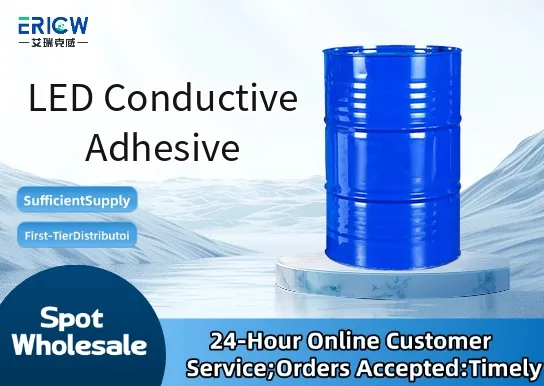
High electrical conductivity with low contact resistance (< 5 mΩ per bond joint) for stable LED current transfer.
Thermally conductive formulation (1.2–1.8 W/m·K) to support efficient heat dissipation from high-power LED chips.
Room-temperature cure option available, plus accelerated curing at 120–150 °C for high-throughput assembly lines.
Excellent adhesion to common LED substrates including AlN, FR-4, metal-core PCBs (MCPCBs), and ceramic packages.
Halogen-free and RoHS 3 compliant, formulated without brominated flame retardants or heavy metals.
Die-attach bonding of mid-power and high-power LED chips in general lighting modules.
Interconnection of COB (Chip-on-Board) LED arrays on aluminum or ceramic substrates.
Attachment of SMD LED components requiring both electrical continuity and thermal management.
Bonding of UV-LED emitters in curing and disinfection systems where low outgassing is critical.
Repair and rework of failed LED assemblies in automotive interior lighting and display backlighting.
| Chemical Type | Epoxy-based thermoset with silver-coated copper or pure silver filler |
| Product Form | Paste (syringe or cartridge); also available in preform discs |
| Appearance | Uniform gray-silver paste; no visible sedimentation after recommended storage |
| Melting Point / Softening Range | No true melting point; glass transition temperature (Tg) ≈ 135 °C |
| Primary Applications | LED die-attach, chip interconnect, thermal interface bonding |
| Key Features | Low ionic residue, non-corrosive, low shrinkage (< 1.2% vol.) upon cure |
| Benefits | Enables miniaturization, improves lumen maintenance, extends LED lifetime under thermal cycling |
| Regulatory Compliance | RoHS 3 (2015/863/EU), REACH SVHC-free, UL 94 V-0 rated (cured film) |
| Common Compatible Systems | Suitability |
| Dispensing Equipment (e.g., Nordson ASX, Musashi MV2) | Highly Recommended – Optimized rheology for consistent 10–50 µm dot deposition |
| Reflow Ovens (Nitrogen or Air Atmosphere) | Recommended – Compatible with standard LED reflow profiles (peak 150 °C, 60–90 sec) |
| Automated Optical Inspection (AOI) Platforms | Suitable – Low halogen content minimizes lens fogging; non-volatile post-cure |
| Plasma Surface Treatment Systems (O2/Ar) | Highly Recommended – Enhances wettability and bond strength on oxidized metal substrates |
Q1: What is the CAS Registry Number for this LED Conductive Adhesive?
A: This is a proprietary multi-component formulation; individual CAS numbers apply only to raw materials (e.g., silver flake: 7440-22-4; epoxy resin base: 25068-38-6). Full composition is protected under trade secret and supplied under NDA upon request.
Q2: What is the recommended dispensing volume per LED die (e.g., 1.0×1.0 mm chip)?
A: Typical volume is 15–25 nL per die for optimal coverage and void minimization; exact dosage depends on substrate roughness, stencil design, and required bond line thickness (target: 15–25 µm).
Q3: How does this adhesive compare to solder-based die-attach in terms of thermal reliability?
A: Unlike lead-free solders, it avoids brittle intermetallic formation and offers superior thermal cycle performance (>2,000 cycles @ −40 °C to +125 °C) due to elastic modulus tuning and CTE matching to common LED substrates.
Q4: Are there any known migration or ion extraction concerns under humid operating conditions?
A: No measurable silver or chloride ion migration observed after 1,000 hrs at 85 °C/85% RH per JESD22-A101; ionic contamination < 0.2 µg/cm² NaCl equivalent (per IPC-TM-650 2.3.25).
Contact With Us:
E-mail: wangxingqiang@ericwchem.com
Have a Questions? Call Us:
Add:
Building A1, Jiete Industrial Park, Huangpu District, Guangzhou City, Guangdong Province, China