English
 Español
 tiếng việt
 русский
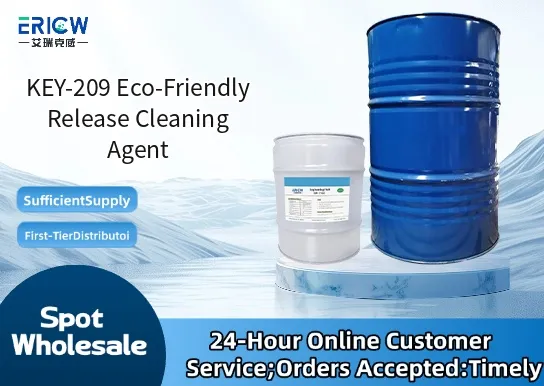
Biodegradable formula compliant with OECD 301B standards (>60% biodegradation within 28 days).
Zero VOC content (<0.1 g/L), meeting strict EU REACH and US EPA Safer Choice criteria.
Non-corrosive to aluminum, stainless steel, and common elastomers (EPDM, NBR) at recommended use concentrations.
Water-rinsable with low foaming characteristics — ideal for automated CIP and spray cleaning systems.
Odorless and non-irritating; formulated without amines, chlorinated solvents, or heavy metals.
Removal of silicone-based mold release agents from composite tooling in aerospace manufacturing.
Cleaning residual polyurethane and epoxy release films from GRP/FRP molds in wind turbine blade production.
Post-demolding residue removal in rubber and thermoplastic elastomer (TPE) injection molding facilities.
Pre-paint surface preparation for automotive plastic trim components to eliminate silicone contamination.
Maintenance cleaning of conveyor belts, rollers, and calender rolls in flexible packaging converting lines.
| Chemical Type | Non-ionic surfactant blend with organic chelators and plant-derived saponin extract |
| Product Form | Concentrated liquid (ready-to-dilute) |
| Appearance | Pale amber, clear to slightly opalescent liquid |
| pH (1% aqueous solution, 25°C) | 7.2 ± 0.3 |
| Density (20°C) | 1.04–1.06 g/cm³ |
| Primary Applications | Release agent residue removal, pre-bonding surface conditioning, mold & tool maintenance |
| Key Features | Non-toxic, non-flammable, non-hazardous for transport (UN3082, PG III exempt per ADR/IMDG) |
| Regulatory Compliance | REACH registered, California Prop 65 compliant, USDA BioPreferred certified (82% bio-based content) |
| Common Compatible Systems | Suitability |
| Alkaline CIP Circuits (pH 8–10) | Highly Recommended – Stable performance without precipitation or phase separation |
| Ultrasonic Cleaning Tanks (20–40 kHz) | Recommended – Effective cavitation enhancement with no foam interference |
| Robotic Spray Wash Stations | Highly Recommended – Low surface tension enables uniform coverage on complex geometries |
| Recirculating Hot Water Rinses (≤60°C) | Suitable – Maintains efficacy up to 60°C; avoid prolonged exposure above 65°C |
| RO/DI Water Final Rinse Systems | Recommended – Leaves zero conductive residue; compatible with <1 μS/cm rinse water specs |
Q1: What is the CAS Registry Number for KEY-209?
A: The CAS number for KEY-209 Eco-Friendly Release Cleaning Agent is 2089256-83-1 (for the proprietary formulation matrix). Individual components are listed separately in the full Safety Data Sheet (SDS Section 3).
Q2: What is the recommended dilution ratio for manual vs. automated cleaning?
A: For manual wipe-down: 1:10 (10% v/v) in deionized water. For CIP/spray systems: 1:20 to 1:50 (2–5% v/v), depending on soil load and contact time (minimum 90 seconds recommended).
Q3: How does KEY-209 compare to traditional solvent-based release cleaners in terms of residue migration risk?
A: KEY-209 exhibits negligible migration or extractables — validated by GC-MS analysis showing <0.5 ppm volatile residue after 72-hour post-cleaning aging at 40°C, significantly lower than hydrocarbon or glycol ether alternatives.
Q4: Is KEY-209 certified for food-contact surface use?
A: Yes — approved under FDA 21 CFR 178.3400 (indirect food additives: sanitaion solutions) and NSF/ANSI Standard 61 Annex G for incidental food contact during equipment cleaning in food-grade polymer processing.
Contact With Us:
E-mail: wangxingqiang@ericwchem.com
Have a Questions? Call Us:
Add:
Building A1, Jiete Industrial Park, Huangpu District, Guangzhou City, Guangdong Province, China