English
 Español
 tiếng việt
 русский
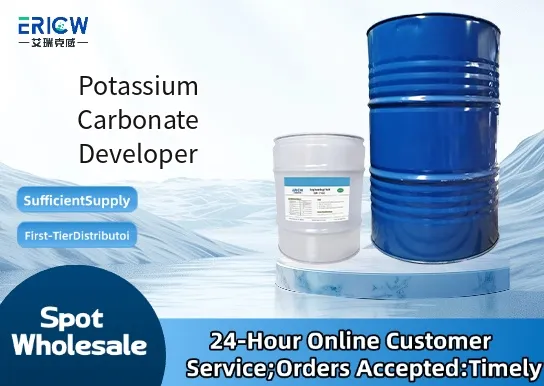
High-purity anhydrous potassium carbonate ensures consistent alkalinity and minimal impurity interference in sensitive chemical processes.
Fast-dissolving granular form enables rapid, uniform dissolution in aqueous developer systems without residue or cloudiness.
Non-volatile and thermally stable up to 891 °C, supporting high-temperature processing environments without decomposition.
Low chloride and sulfate content (<50 ppm each) minimizes corrosion risk in stainless steel and aluminum equipment.
Controlled particle size distribution (90% < 250 µm) enhances flowability, dosing accuracy, and mixing efficiency in automated feed systems.
Alkaline developer formulation for photopolymer printing plates (e.g., flexographic and letterpress plate processing).
pH adjuster and buffering agent in water-based inkjet ink development and pigment dispersion stabilization.
Co-developer component in semiconductor photoresist stripping and post-exposure bake (PEB) enhancement solutions.
Activator in silver halide-based photographic film and paper developing chemistry (industrial archival grade).
Reagent in catalytic synthesis of organic carbonates and potassium-catalyzed transesterification reactions.
| Chemical Type | Anhydrous potassium carbonate (K₂CO₃) |
| Product Form | Free-flowing white granules |
| Appearance | White, crystalline, odorless solid |
| Melting Point | 891 °C (decomposes without melting) |
| Primary Applications | Alkaline developers, pH control, catalyst support, photochemical processing |
| Key Features | High solubility (112 g/100 mL water at 20 °C), low heavy metals, non-hygroscopic under controlled storage |
| Benefits | Predictable reactivity, extended shelf life (>24 months in sealed HDPE), reduced rinse water demand |
| Regulatory Compliance | REACH registered; compliant with FDA 21 CFR 184.1613 (food-grade indirect use); non-REACH SVHC listed |
| Common Compatible Systems | Suitability |
| Aqueous alkaline developer concentrates (pH 10.5–12.0) | Highly Recommended – Provides optimal buffering capacity and ion stability |
| Photopolymer plate processing lines (e.g., DuPont Cyrel®, Flint Group) | Highly Recommended – Validated for compatibility with standard washout and drying cycles |
| Water-based flexo ink manufacturing systems | Recommended – Requires pre-dissolution and filtration to avoid grit formation |
| Electroless plating bath additives | Suitable – Effective as a pH stabilizer; monitor carbonate accumulation in long-term operation |
Q1: What is the CAS Number for Potassium Carbonate Developer?
A: The CAS Registry Number is 584-08-7 for anhydrous potassium carbonate, which applies to this developer-grade material.
Q2: What is the recommended dosage range in aqueous developer formulations?
A: Typical concentration ranges from 3–12 wt% in final working solutions, depending on required pH (target 10.8–11.6) and substrate sensitivity; always validate via titration and process testing.
Q3: How does Potassium Carbonate Developer compare to Sodium Carbonate in photochemical applications?
A: Potassium carbonate offers higher solubility, lower solution viscosity, and reduced risk of sodium-induced haze or crystallization on sensitive imaging layers — making it preferred for high-resolution photopolymer systems.
Q4: Is migration or leaching of potassium ions a concern in food-contact printing applications?
A: No measurable migration occurs under standard offset/flexo printing conditions per EU 10/2011 and FDA 21 CFR Part 176.170 testing protocols; residual surface levels remain below detectable limits (<0.1 ppm) after proper curing and post-treatment.
Contact With Us:
E-mail: wangxingqiang@ericwchem.com
Have a Questions? Call Us:
Add:
Building A1, Jiete Industrial Park, Huangpu District, Guangzhou City, Guangdong Province, China