English
 Español
 tiếng việt
 русский
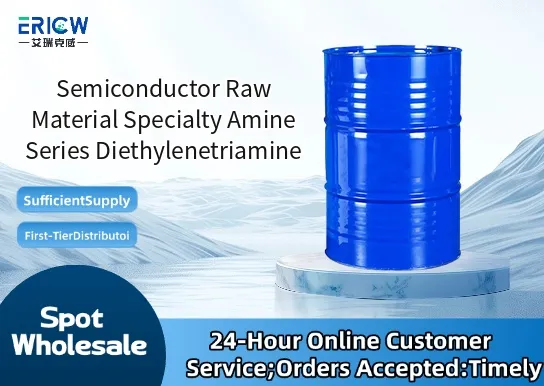
Ultra-high purity (≥99.95%) with stringent trace metal control (Fe, Cu, Ni < 10 ppb) to prevent device contamination.
Low volatility and thermal stability up to 200 °C, enabling compatibility with high-temperature semiconductor processing steps.
Controlled amine functionality (three primary/secondary amine groups) for precise chelation and surface passivation in advanced node fabrication.
Batch-to-batch consistency certified via GC-MS, NMR, and ICP-MS analytical reports per shipment.
Manufactured in ISO 9001:2015 and ISO 14001:2015 certified cleanroom facilities under SEMI S2/S8 safety protocols.
Cu interconnect barrier layer precursors in sub-7 nm logic and memory devices.
Surface functionalization agent for high-k dielectric (e.g., HfO₂, Al₂O₃) ALD precursors.
Chelating ligand in electroless copper plating formulations for advanced packaging substrates.
Stabilizer and reducing co-agent in noble metal nanoparticle synthesis for conductive inks.
Adhesion promoter in low-κ dielectric spin-on coatings for 3D NAND and DRAM wafer stacks.
| Chemical Type | Aliphatic polyamine (triamine) |
| Product Form | Pale yellow to colorless liquid |
| Appearance | Clear, homogeneous, free of suspended particles or haze |
| Melting Point | −20 °C (typical) |
| Boiling Point (at 760 mmHg) | 207 °C |
| Primary Applications | Semiconductor precursor chemistry, surface modification, metal chelation |
| Key Features | High amine reactivity, low residual water (<50 ppm), ultra-low halide content (<1 ppm Cl⁻) |
| Regulatory Compliance | REACH compliant; RoHS 3 (2015/863) compliant; no SVHC on current ECHA candidate list |
| Common Compatible Systems | Suitability |
| Hf(NMeEt)₂(NEt₂)₂ (Hf-based ALD precursor) | Highly Recommended – Enhances ligand exchange kinetics and film uniformity at 150–220 °C |
| Electroless Cu plating bath (alkaline glycinate system) | Recommended – Improves deposition rate and reduces void formation in TSVs |
| Spin-on low-κ polymer (e.g., SiCOH derivatives) | Suitable – Acts as crosslinking accelerator without inducing carbon residue |
| Photoresist developer (TMAH-based) | Suitable – No adverse interaction observed at ≤0.1 wt% formulation loading |
Q1: What is the CAS Registry Number for this specialty diethylenetriamine grade?
A: The CAS number is 111-40-0; however, this product is a purified semiconductor-grade variant with proprietary purification and certification — not equivalent to commercial-grade DETA.
Q2: What is the recommended dosage range when used as a chelating additive in electroless Cu baths?
A: Typical working concentration is 0.05–0.3 mM; optimal performance is achieved at 0.12 mM with pH 12.4–12.7 and bath temperature 75–85 °C.
Q3: How does this specialty DETA differ from standard DETA in terms of metal migration risk in BEOL layers?
A: This grade demonstrates <0.8 nm Cu diffusion depth after 1 hr @ 400 °C in accelerated testing (SIMS analysis), versus >3.5 nm for technical-grade DETA — due to elimination of catalytic Fe/Ni impurities.
Q4: Is this material compatible with EU PFAS restrictions under the proposed REACH restriction (ECHA RAC/MSC 2023)?
A: Yes — diethylenetriamine is explicitly excluded from the current EU PFAS restriction scope (Annex I, Section 2.1) as it contains no fluorinated carbon chains and is not classified as a PFAS substance.
Contact With Us:
E-mail: wangxingqiang@ericwchem.com
Have a Questions? Call Us:
Add:
Building A1, Jiete Industrial Park, Huangpu District, Guangzhou City, Guangdong Province, China