English
 Español
 tiếng việt
 русский
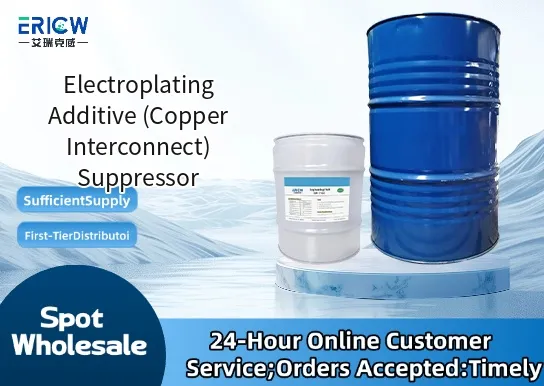
Enables superior bottom-up copper fill with minimal voiding in sub-65 nm interconnect trenches and vias.
Provides robust suppression stability across extended plating bath life and high-current-density operation.
Delivers excellent uniformity and repeatability in damascene electroplating processes for advanced logic and memory devices.
Compatible with standard acid copper sulfate electrolytes without requiring major bath reformulation.
Low-volatility, non-foaming formulation ensures consistent mass transfer and reduced maintenance downtime.
Front-end-of-line (FEOL) copper interconnect metallization for 7 nm to 28 nm node semiconductor manufacturing.
Advanced packaging applications including fan-out wafer-level packaging (FOWLP) and 2.5D/3D TSV plating.
Copper seed layer reinforcement and gap-fill enhancement in dual-damascene structures.
High-aspect-ratio via filling for RF and power IC interconnects.
Electrochemical metallization in advanced microelectronic substrates (e.g., silicon interposers, glass substrates).
| Chemical Type | Sulfonated polyether-based suppressor with tailored terminal functionality |
| Product Form | Aqueous liquid concentrate (40% w/w active) |
| Appearance | Clear, pale yellow to amber liquid |
| Odor | Faint characteristic odor; non-irritating at recommended handling concentrations |
| pH (1% aqueous solution) | 5.8 – 6.4 |
| Density (25°C) | 1.08 – 1.12 g/cm³ |
| Primary Applications | Copper electroplating suppressor for semiconductor interconnect damascene processes |
| Regulatory Compliance | REACH registered; RoHS 2015/863 compliant; no SVHCs above threshold |
| Common Compatible Systems | Suitability |
| Applied Materials SABRE™ G2 / G3 Plating Systems | Highly Recommended – Validated for full process integration with standard Cu-Suppress-Activator-Accelerator chemistry |
| Lam Research Altus® Max Platform | Highly Recommended – Optimized for low-k dielectric compatibility and ultra-thin barrier layers |
| Technic Inc. Electra® Cu System | Recommended – Requires minor optimization of agitation and temperature setpoints |
| Custom-built acid copper sulfate baths (H₂SO₄/CuSO₄/HCl) | Suitable – Stable performance demonstrated with chloride ion concentration 40–80 ppm |
Q1: What is the CAS Registry Number for this suppressor?
A: The CAS number is 2274032-87-9. This identifier applies to the proprietary active molecular complex; full formulation details are protected under trade secret provisions.
Q2: What is the typical working concentration range in copper plating baths?
A: Recommended dosage is 0.5–2.0 mL/L in standard acid copper sulfate electrolytes (200 g/L CuSO₄·5H₂O, 50–70 g/L H₂SO₄, 40–80 ppm Cl⁻), adjusted based on feature size and current density.
Q3: How does this suppressor differ from conventional PEG-based suppressors?
A: Unlike traditional PEG suppressors, this product features engineered hydrophilic/hydrophobic balance and selective adsorption kinetics, enabling stronger interfacial binding at trench bottoms while maintaining rapid desorption at field regions — resulting in improved superconformal fill and reduced overburden.
Q4: Is extractable residue or metal migration a concern after post-plating cleaning?
A: No significant organic residue remains after standard SC1 (NH₄OH:H₂O₂:H₂O) and dilute HF cleans. ICP-MS testing shows <0.05 ppb residual carbon and undetectable leachable heavy metals (<0.01 ppb) on finished wafers.
Q5: Does this product meet semiconductor industry purity standards (e.g., SEMI C1/C12)?
A: Yes — manufactured and packaged in ISO Class 5 cleanrooms under SEMI F57-compliant controls; certified to SEMI C12 (metal impurities ≤ 10 ppt for Na, K, Fe, Ni, Cr, Zn, Al) and SEMI C1 (particulate count ≤ 25 particles ≥ 0.2 µm per mL).
Contact With Us:
E-mail: wangxingqiang@ericwchem.com
Have a Questions? Call Us:
Add:
Building A1, Jiete Industrial Park, Huangpu District, Guangzhou City, Guangdong Province, China