English
 Español
 tiếng việt
 русский
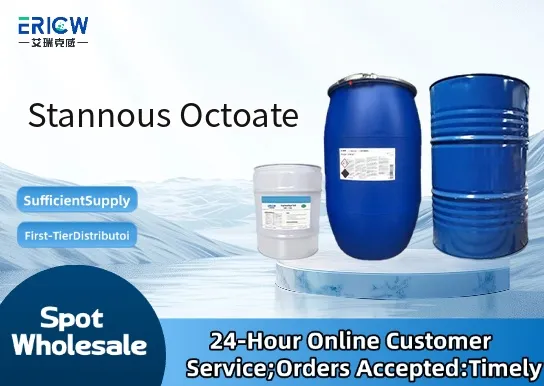
High catalytic efficiency for urethane and polyester polyurethane reactions at ambient to moderate temperatures.
Excellent solubility in common organic solvents including esters, ketones, and aromatic hydrocarbons.
Low volatility and thermal stability up to 180 °C, supporting extended processing windows.
Consistent batch-to-batch performance with strict heavy metal impurity control (Pb, As, Hg < 1 ppm).
Non-corrosive to standard stainless steel process equipment under recommended handling conditions.
Primary catalyst for flexible and rigid polyurethane foam production (slabstock, molded, and spray systems).
Catalyst in moisture-cured polyurethane sealants and adhesives requiring controlled pot life and rapid surface cure.
Key accelerator in silicone RTV-2 (room temperature vulcanizing) two-part condensation-cure systems.
Co-catalyst in polylactic acid (PLA) and polyglycolic acid (PGA) ring-opening polymerization processes.
Reaction promoter in alkyd resin crosslinking and urethane-modified acrylic coatings.
| Chemical Type | Tin(II) 2-ethylhexanoate (Stannous octoate) |
| Product Form | Clear, pale yellow to amber liquid |
| Appearance | Homogeneous, free from sediment or cloudiness |
| Tin (Sn) Content | 20.0 – 22.5 wt% (by titration) |
| Acid Value | 0.5 – 3.0 mg KOH/g |
| Primary Applications | Polyurethane foams, RTV silicones, biopolymer synthesis, coating crosslinking |
| Key Features | High reactivity, low odor, solvent-compatible, non-gelling |
| Regulatory Compliance | REACH registered; compliant with FDA 21 CFR §175.300 for indirect food contact adhesives (when used within limits) |
| Common Compatible Systems | Suitability |
| Polyol–TDI/MDI Blends (Flexible Foam) | Highly Recommended – Delivers balanced cream-to-gel timing and fine cell structure |
| RTV-2 Silicone Base + Crosslinker (e.g., alkoxysilanes) | Highly Recommended – Enables reliable room-temperature cure without premature skinning |
| PLA/PCL Melt Polymerization Systems | Recommended – Effective initiator at 0.05–0.2 wt%, requires inert atmosphere handling |
| Alkyd–Urethane Hybrid Coatings | Suitable – Enhances through-cure; may require co-catalyst (e.g., dibutyltin dilaurate) for optimal film hardness |
Q1: What is the CAS Number for Stannous Octoate?
A: The CAS Registry Number is 301-10-0.
Q2: What is the typical usage level in polyurethane foam formulations?
A: Standard dosage ranges from 0.05 to 0.3 parts per hundred parts polyol (pphp), depending on desired reactivity, density, and foam type — lower levels favor cream time extension, higher levels accelerate gelation.
Q3: How does Stannous Octoate compare to Dibutyltin Dilaurate (DBTDL) in silicone curing?
A: Stannous Octoate offers faster initial surface cure and lower toxicity profile than DBTDL, but exhibits lower hydrolytic stability — it is preferred for one-part acetoxy RTVs, whereas DBTDL remains favored for neutral-cure (oxime/alcohol) systems requiring longer shelf life.
Q4: Is Stannous Octoate subject to migration or extraction concerns in food-contact applications?
A: When formulated within FDA-permitted limits (≤ 0.1% in adhesive layers) and fully cured, extractable tin levels remain below 0.05 ppm in standard food-simulant testing (e.g., 10% ethanol, olive oil at 40 °C for 10 days), meeting EU Framework Regulation (EC) No 1935/2004 requirements.
Contact With Us:
E-mail: wangxingqiang@ericwchem.com
Have a Questions? Call Us:
Add:
Building A1, Jiete Industrial Park, Huangpu District, Guangzhou City, Guangdong Province, China