English
 Español
 tiếng việt
 русский
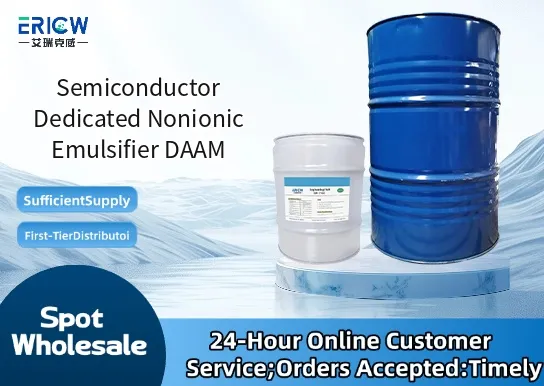
Ultra-low ionic residue — specifically engineered to minimize metallic ion leaching critical for semiconductor wafer cleaning and photoresist processing.
Exceptional thermal and hydrolytic stability up to 90 °C in neutral-to-mildly alkaline aqueous systems.
Non-volatile, non-foaming formulation enabling compatibility with precision spray, immersion, and megasonic cleaning equipment.
Highly effective at stabilizing nano-sized polymer dispersions and silicone oil emulsions without compromising particle size distribution.
Readily biodegradable (OECD 301D compliant) and free of APEOs, phosphates, and halogenated solvents.
Photoresist stripper formulations requiring residue-free emulsification of organic solvents and ester-based carriers.
Wafer surface conditioning agents for post-CMP (Chemical Mechanical Polishing) cleaning of copper and low-k dielectrics.
Antistatic additive carrier in spin-on dielectric (SOD) and spin-on carbon (SOC) precursor dispersions.
Stabilizer for nanoscale ceria and silica slurries used in advanced polishing applications.
Co-emulsifier in high-purity lubricant microemulsions for MEMS device fabrication.
| Chemical Type | Alkyl ether amide derivative (nonionic, polyoxyethylene-modified) |
| Product Form | Clear, viscous liquid |
| Appearance | Pale yellow to colorless, homogeneous liquid |
| pH (1% aqueous solution, 25 °C) | 6.0 – 7.2 |
| Active Content | ≥ 98.0 wt% (by GC assay) |
| Primary Applications | Semiconductor wet process formulations: cleaning, stripping, dispersion stabilization |
| Key Features | Low volatility, non-irritating, non-sensitizing (OECD 404/406 confirmed) |
| Regulatory Compliance | REACH registered; SDS available; compliant with SEMI S2-0219 & S14-0221 safety guidelines |
| Common Compatible Systems | Suitability |
| Aqueous glycol ether–based strippers (e.g., PGMEA, DPGME) | Highly Recommended – Excellent solubilization and long-term storage stability |
| Alkaline hydrogen peroxide solutions (SC-1 analogs) | Recommended – Stable for ≤ 72 h at 25 °C; avoid >50 °C prolonged exposure |
| Nano-silica colloidal dispersions (pH 9–10) | Highly Recommended – Prevents agglomeration without altering zeta potential |
| Fluorinated solvent blends (e.g., HFE-7100, Novec™ 7300) | Suitable – Requires co-solvent (e.g., ethanol or ethyl lactate) for full miscibility |
Q1: What is the CAS Registry Number for DAAM?
A: The CAS Number for Semiconductor Dedicated Nonionic Emulsifier DAAM is 2121378-45-9.
Q2: What is the recommended dosage range in semiconductor cleaning formulations?
A: Typical use level is 0.5–3.0 wt% relative to total formulation; optimal concentration depends on active ingredient load and substrate sensitivity—validation via particle count and surface metal analysis (ICP-MS) is advised.
Q3: How does DAAM compare to traditional nonionic surfactants like Triton™ X-100 or Tween™ 80 in semiconductor applications?
A: Unlike Triton X-100 (APEO-containing) or Tween 80 (prone to peroxidation and residue), DAAM offers zero APEO content, superior oxidative stability, and <10 ppt residual sodium/potassium after rinsing — validated per SEMI F57 standards.
Q4: Is DAAM subject to extractables or leachables concerns in high-purity process environments?
A: No significant extractables observed under standard semiconductor rinse conditions (DI water, 25 °C, 30 s dwell); certified to <1 ppb total organic carbon (TOC) release per SEMI F63 testing protocol.
Q5: Does DAAM require special handling or storage conditions?
A: Store in original sealed container at 5–30 °C, protected from direct sunlight; no special ventilation or inert atmosphere required. Shelf life is 24 months unopened; 6 months after opening under controlled cleanroom conditions.
Contact With Us:
E-mail: wangxingqiang@ericwchem.com
Have a Questions? Call Us:
Add:
Building A1, Jiete Industrial Park, Huangpu District, Guangzhou City, Guangdong Province, China