English
 Español
 tiếng việt
 русский
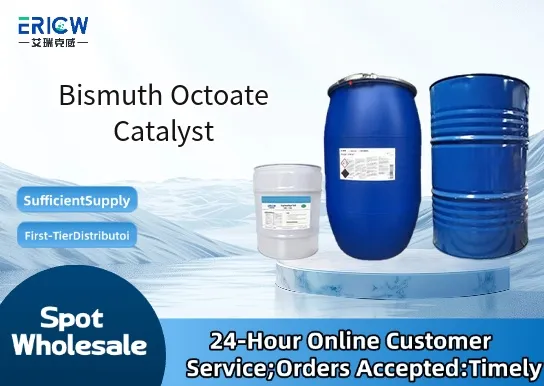
Non-toxic heavy-metal alternative to traditional tin-based catalysts (e.g., DBTDL), supporting safer handling and regulatory compliance.
High catalytic activity for urethane and polyester polyurethane reactions at ambient to moderate temperatures (20–80 °C).
Excellent hydrolytic stability — maintains performance in moisture-sensitive formulations without premature decomposition.
Low volatility and negligible odor, enhancing workplace safety and reducing VOC emissions during processing.
Compatible with both aromatic and aliphatic isocyanates, offering formulation flexibility across diverse polyurethane chemistries.
Flexible and rigid polyurethane foams for automotive seating, bedding, and insulation.
Coatings and adhesives requiring low-VOC, non-staining, and fast-cure profiles (e.g., industrial wood finishes).
Cast elastomers and microcellular systems where controlled gel time and dimensional stability are critical.
One-component moisture-curing polyurethane sealants and caulks.
Biodegradable polyurethane formulations leveraging bismuth’s favorable environmental profile.
| Chemical Type | Bismuth(III) 2-ethylhexanoate (Bismuth Octoate) |
| Product Form | Clear, viscous liquid |
| Appearance | Pale yellow to amber transparent liquid |
| Melting Point | Approx. –15 °C (liquid at room temperature) |
| Primary Applications | Polyurethane foam, coatings, adhesives, sealants, elastomers |
| Key Features | Non-tin, low-volatility, hydrolytically stable, isocyanate-reactive |
| Benefits | Reduced toxicity risk, improved worker safety, REACH-compliant, suitable for eco-label-certified products |
| Regulatory Compliance | REACH registered; not classified as CMR or PBT under EU CLP; SDS available upon request |
| Common Compatible Systems | Suitability |
| Polyether-based flexible PU foams | Highly Recommended – Delivers optimal cream-to-gel timing and fine cell structure |
| Polyester-based rigid PU foams | Recommended – Effective gel catalyst; may require minor adjustment of amine co-catalyst levels |
| Aliphatic HDI-based polyurethane coatings | Highly Recommended – No yellowing, excellent pot life control, and film clarity retention |
| Moisture-curing one-component PU sealants | Suitable – Provides consistent cure depth and adhesion; verify compatibility with specific silane modifiers |
Q1: What is the CAS Registry Number for Bismuth Octoate Catalyst?
A: The CAS number is 301-10-0 (Bismuth(III) 2-ethylhexanoate).
Q2: What is the typical dosage range in polyurethane formulations?
A: Standard loading is 0.05–0.3 phr (parts per hundred resin) relative to polyol; optimal level depends on isocyanate type, desired reactivity, and co-catalyst synergy.
Q3: How does Bismuth Octoate compare to dibutyltin dilaurate (DBTDL)?
A: Bismuth Octoate offers comparable gel catalysis with significantly lower toxicity, no reproductive hazard classification, and greater thermal stability—though it exhibits slightly lower blowing catalysis than DBTDL in some foam systems.
Q4: Is Bismuth Octoate compliant with food-contact or medical device regulations?
A: It is not FDA-approved for direct food contact or implantable medical devices; however, it is widely accepted in indirect food-packaging adhesives and industrial coatings where migration testing confirms <1 ppb bismuth extractables under intended use conditions.
Q5: Does Bismuth Octoate migrate or leach from cured polyurethane matrices?
A: When fully reacted and crosslinked, bismuth remains tightly bound in the polymer network; validated extraction studies (e.g., EN 13130, ISO 10993-12) show negligible leaching (<0.05 ppm) in aqueous and alcoholic simulants under standard conditions.
Contact With Us:
E-mail: wangxingqiang@ericwchem.com
Have a Questions? Call Us:
Add:
Building A1, Jiete Industrial Park, Huangpu District, Guangzhou City, Guangdong Province, China