English
 Español
 tiếng việt
 русский
High electrical conductivity (1–10 S/cm) in its doped emeraldine salt form.
Excellent environmental stability under ambient conditions and moderate humidity.
Reversible redox activity enabling tunable conductivity via pH or dopant control.
Good thermal stability up to 200 °C in inert atmosphere.
Solution-processable in common polar aprotic solvents (e.g., NMP, m-cresol) for coating and blending.
Antistatic coatings for electronic packaging films and plastic containers.
Electrode materials in flexible supercapacitors and pseudocapacitive energy storage devices.
Corrosion-inhibiting primers for carbon steel in marine and industrial infrastructure.
Chemiresistive sensing layers for ammonia, NO₂, and volatile organic compound (VOC) detection.
Conductive fillers in polymer composites for EMI shielding housings and automotive electronics.
| Chemical Type | Emeraldine salt form of polyaniline (doped with camphorsulfonic acid or HCl) |
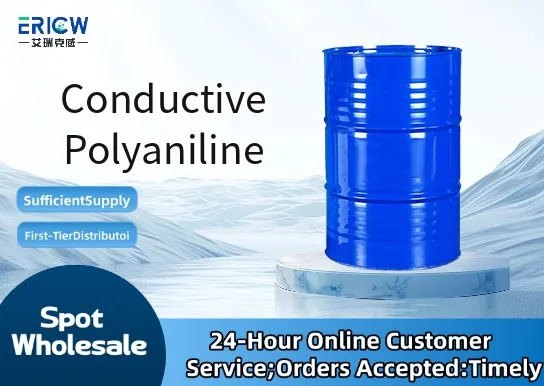
| Product Form | Free-flowing dark green to black powder |
| Appearance | Uniform granular powder; no visible agglomerates |
| Primary Applications | Antistatic additives, corrosion protection, sensor elements, EMI shielding composites |
| Key Features | Water-dispersible (with surfactant assistance), thermally stable up to 200 °C (N₂), pH-responsive conductivity |
| Benefits | Halogen-free conduction mechanism, lower density vs. metal fillers, scalable synthesis |
| Regulatory Compliance | REACH registered; RoHS compliant (Pb, Cd, Hg, Cr⁶⁺, PBB, PBDE below thresholds) |
| Storage Conditions | Store in sealed container under dry nitrogen at 5–25 °C; protect from light and moisture |
| Common Compatible Systems | Suitability |
| Epoxy resins (e.g., DGEBA-based systems) | Highly Recommended – Excellent dispersion and interfacial adhesion; enhances anticorrosive performance |
| Polyurethane (aliphatic & aromatic) | Recommended – Requires solvent-assisted pre-dispersion; retains flexibility and conductivity |
| Acrylic latex dispersions | Suitable – Compatible with anionic stabilizers; effective for antistatic textile coatings |
| Poly(vinyl alcohol) (PVA) aqueous solutions | Recommended – Forms stable conductive films; ideal for flexible sensor substrates |
Q1: What is the CAS Registry Number for Conductive Polyaniline?
A: The CAS number for emeraldine salt-type conductive polyaniline (HCl-doped) is 9002-97-1. Note: Exact CAS may vary slightly depending on dopant and synthesis route; confirm with batch-specific CoA.
Q2: What is the typical loading level required to achieve percolation conductivity in polymer composites?
A: Percolation threshold typically ranges from 1.5–5.0 wt% in thermoplastics (e.g., ABS, PC) and 0.8–3.0 wt% in thermosets (e.g., epoxy), depending on dispersion quality and matrix polarity.
Q3: How does Conductive Polyaniline compare to carbon black or metallic fillers in EMI shielding applications?
A: Polyaniline offers lower density, better corrosion resistance, and halogen-free conduction vs. metal fillers, while providing broader frequency-range absorption than carbon black—though absolute shielding effectiveness (SE) is generally lower than silver-coated particles at equivalent loadings.
Q4: Is Conductive Polyaniline subject to migration or leaching in humid or aqueous environments?
A: Undoped polyaniline exhibits low water solubility, but acid-doped forms may undergo partial dedoping and ion leaching above pH 4. For wet-end applications, crosslinking or encapsulation (e.g., silica shell) is recommended to minimize extractables.
Q5: Does this material comply with FDA or EU food-contact regulations?
A: Standard Conductive Polyaniline is not approved for direct food contact under FDA 21 CFR or EU Regulation (EC) No 10/2011. It may be used in non-migrating, barrier-layer configurations only after full application-specific migration testing and regulatory review.
Contact With Us:
E-mail: wangxingqiang@ericwchem.com
Have a Questions? Call Us:
Add:
Building A1, Jiete Industrial Park, Huangpu District, Guangzhou City, Guangdong Province, China