English
 Español
 tiếng việt
 русский
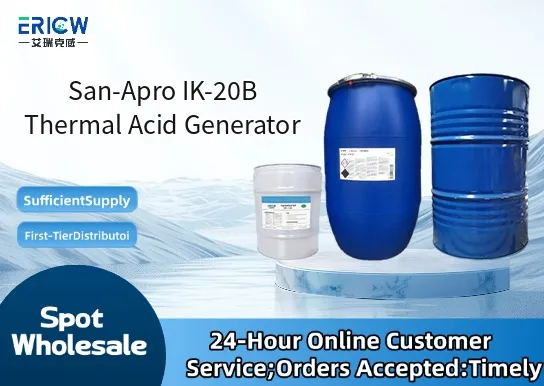
Thermally activated, latent acid generator with sharp onset decomposition at 135–145 °C.
High purity crystalline solid ensuring consistent performance in precision photoresist and crosslinking formulations.
Low volatility and negligible sublimation below 120 °C, enhancing formulation stability and shelf life.
Generates sulfonic acid upon thermal activation—ideal for catalyzing acid-sensitive reactions without premature curing.
Compatible with common industrial solvents including propylene glycol monomethyl ether acetate (PGMEA), ethyl lactate, and cyclohexanone.
Chemically amplified photoresists for advanced semiconductor lithography (i-line, KrF, and ArF).
Thermosetting epoxy and phenolic resin systems requiring controlled post-bake acid catalysis.
Positive-tone resist top-coat layers for anti-reflective and planarization applications.
Microelectromechanical systems (MEMS) packaging adhesives with low outgassing requirements.
High-resolution color filter and TFT array manufacturing in flat-panel display fabrication.
| Chemical Type | Sulfonium salt derivative (triphenylsulfonium triflate analog) |
| Product Form | Free-flowing white to off-white crystalline powder |
| Appearance | Crystalline solid, homogeneous granular morphology |
| Melting Point (DSC onset) | 138–142 °C (measured at 10 °C/min under N₂) |
| Primary Applications | Photoacid generator (PAG) for thermal post-exposure bake (PEB) in semiconductor resists |
| Key Features | Latent reactivity, high thermal stability below activation threshold, low halogen content |
| Benefits | Enables high resolution, low line-edge roughness (LER), and improved process window control |
| Regulatory Compliance | REACH registered; RoHS 2015/863 compliant; no SVHCs above threshold per EU Annex XIV |
| Common Compatible Systems | Suitability |
| Novolac-based i-line photoresists | Highly Recommended – Proven compatibility with standard novolac/diazonaphthoquinone matrices |
| Acrylic-based KrF resists (e.g., PHS derivatives) | Recommended – Requires optimization of PEB temperature profile for optimal deprotection yield |
| Epoxy-phenolic molding compounds | Suitable – Effective catalyst for crosslinking at 150–170 °C; verify residual acidity impact on wire bondability |
| Polyimide precursor formulations | Recommended – Compatible with solvent-cast polyamic acid systems; supports imidization acceleration |
Q1: What is the CAS Registry Number for San-Apro IK-20B?
A: The CAS number for San-Apro IK-20B is 181028-59-9. This identifier corresponds specifically to the triarylsulfonium trifluoromethanesulfonate variant used in this grade.
Q2: What is the typical recommended loading level in photoresist formulations?
A: Standard loading ranges from 1.5 to 5.0 wt% relative to total solid content, depending on resist architecture and required acid diffusion length. Optimization via dose-to-clear testing is strongly advised.
Q3: How does IK-20B differ from San-Apro IK-10A in terms of thermal behavior?
A: IK-20B exhibits a ~15 °C higher decomposition onset than IK-10A, offering greater thermal latency during pre-bake steps and reduced risk of premature acid generation in multi-layer stack processes.
Q4: Is San-Apro IK-20B subject to migration or extractable residue concerns in food-contact or medical device applications?
A: San-Apro IK-20B is not intended nor qualified for direct food-contact or implantable medical device use. Its molecular weight (>500 g/mol) and low volatility limit migration, but it has not undergone FDA 21 CFR or ISO 10993 evaluation.
Q5: Does IK-20B require special handling or storage conditions?
A: Store in original sealed container at 2–8 °C, protected from moisture and ambient light. Avoid repeated freeze-thaw cycles. Handle in well-ventilated areas; use nitrile gloves and safety goggles per SDS Section 8.
Contact With Us:
E-mail: wangxingqiang@ericwchem.com
Have a Questions? Call Us:
Add:
Building A1, Jiete Industrial Park, Huangpu District, Guangzhou City, Guangdong Province, China