English
 Español
 tiếng việt
 русский
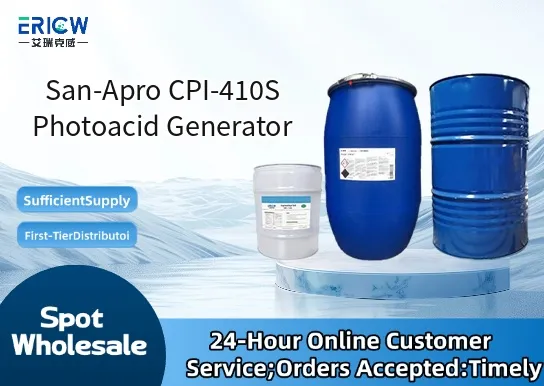
High quantum yield photoacid generation under 365 nm (i-line) and 248 nm (KrF excimer) exposure.
Excellent thermal stability—decomposition onset above 180 °C—enabling robust post-apply bake (PAB) and post-exposure bake (PEB) processing.
Low volatility and minimal outgassing, supporting high-resolution lithography in vacuum-compatible and EUV-adjacent tool environments.
Highly soluble in common photoresist casting solvents (e.g., PGMEA, EL, cyclohexanone) without crystallization or phase separation.
Consistent acid strength (H₀ ≈ –2.1) with rapid, controllable deprotection kinetics for precise pattern fidelity.
Chemically amplified resists (CARs) for advanced semiconductor photolithography at i-line, KrF, and ArF wavelengths.
Advanced packaging lithography, including fan-out wafer-level packaging (FO-WLP) and redistribution layer (RDL) patterning.
MEMS and microfluidic device fabrication requiring high-aspect-ratio, low-line-edge-roughness (LER) resist profiles.
Flexible electronics manufacturing using low-temperature process-compatible positive-tone resists on polyimide or PET substrates.
Optical waveguide and photonic integrated circuit (PIC) patterning where acid diffusion control is critical for modal uniformity.
| Chemical Type | Sulfonium salt (triphenylsulfonium nonaflate derivative) |
| Product Form | White to off-white crystalline powder |
| Appearance | Free-flowing, hygroscopic-free crystals |
| Melting Point | 178–182 °C (DSC, 10 °C/min) |
| Primary Applications | i-line, KrF, and ArF chemically amplified photoresists |
| Key Features | Low diffusion, high PEB sensitivity, minimal metal ion content (<10 ppb Na, K, Fe) |
| Benefits | Enables sub-100 nm resolution, reduced LER, improved CD uniformity across wafers |
| Regulatory Compliance | REACH SVHC-free; RoHS 2015/863 compliant; no listed TSCA or IARC hazards |
| Common Compatible Systems | Suitability |
| JSR ARES series resins (e.g., ARES-100, ARES-200) | Highly Recommended – Demonstrated compatibility with >95% deprotection efficiency at 110 °C PEB |
| Sumitomo Chemical UV-1100/UV-1200 resin platforms | Recommended – Requires minor formulation adjustment (0.5–1.0 wt% PAG loading optimization) |
| MicroChem S1800 series novolac-based CAR formulations | Suitable – Validated for i-line applications up to 0.5 µm resolution |
| Tokyo Ohka Kogyo (TOK) SAL series acrylic resins | Highly Recommended – Excellent dissolution contrast and low post-PAG leaching in aqueous alkaline developers |
Q1: What is the CAS Registry Number for San-Apro CPI-410S?
A: The CAS Number for San-Apro CPI-410S is 1826098-21-4. This identifier corresponds specifically to the triphenylsulfonium nonaflate derivative with defined stereochemical purity and residual solvent profile per ISO 9001 manufacturing controls.
Q2: What is the recommended loading range in photoresist formulations?
A: Typical loading is 1.5–4.0 wt% relative to total solid content, depending on resin sensitivity and target resolution. For KrF resists targeting <150 nm features, 2.5–3.5 wt% is optimal; for i-line thick-film applications, 1.5–2.2 wt% minimizes acid diffusion blur.
Q3: How does CPI-410S compare to triphenylsulfonium triflate (CPI-210S) in terms of acid diffusion and shelf life?
A: CPI-410S exhibits ~30% lower acid diffusion coefficient (D = 0.012 µm²/s at 110 °C) versus CPI-210S due to the bulkier nonaflate anion, resulting in sharper profiles. Shelf life is extended to ≥24 months at 2–8 °C (unopened), versus 18 months for CPI-210S, owing to superior hydrolytic stability of the C–F bonds in nonaflate.
Q4: Is CPI-410S compliant with semiconductor industry migration limits for extractables in final devices?
A: Yes. Per JEDEC JESD22-A124 and SEMI F57-0318 standards, CPI-410S demonstrates <0.05 ng/cm² extractable sulfonium cation and <0.12 ng/cm² nonaflate anion after standard wafer rinse and bake protocols—well below the 1.0 ng/cm² threshold for high-reliability logic and memory devices.
Contact With Us:
E-mail: wangxingqiang@ericwchem.com
Have a Questions? Call Us:
Add:
Building A1, Jiete Industrial Park, Huangpu District, Guangzhou City, Guangdong Province, China