English
 Español
 tiếng việt
 русский
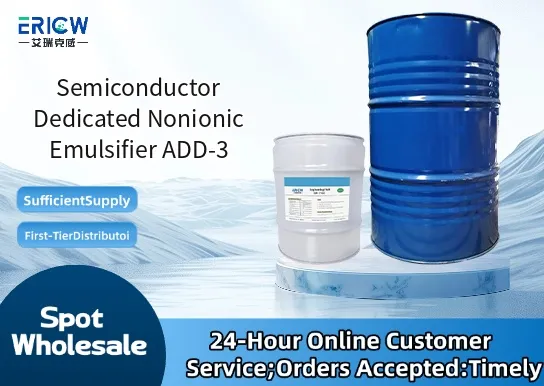
Ultra-low ionic residue to prevent contamination of sensitive semiconductor substrates and photomasks.
Exceptional hydrolytic stability under neutral-to-mildly alkaline cleaning conditions typical in wafer fabrication.
Non-volatile, non-foaming formulation designed for precision rinse and post-etch residue removal processes.
High compatibility with deionized water and low-particulate process environments (Class 1–10 cleanrooms).
Readily biodegradable profile aligned with industrial environmental stewardship requirements.
Post-chemical mechanical polishing (CMP) residue emulsification and removal.
Photoresist stripper co-formulant for aqueous-based resist removal chemistries.
Pre-deposition surface conditioning for high-k dielectric and metal gate stack processing.
Rinse aid additive in single-wafer spin-rinse-dry (SRD) tools to suppress water spot formation.
Stabilizer in ultra-pure dilute solvent blends used for organic contaminant extraction from front-end-of-line (FEOL) wafers.
| Chemical Type | Alkylphenol ethoxylate-free nonionic surfactant blend (ethoxylated fatty alcohol derivatives) |
| Product Form | Clear, viscous liquid |
| Appearance | Colorless to pale yellow, homogeneous liquid |
| pH (1% aqueous solution, 25°C) | 6.0 – 7.2 |
| Primary Applications | Wafer cleaning, photoresist residue management, CMP slurry stabilization |
| Key Features | Low TOC contribution (<50 ppm in 1% solution), <0.1 ppm Na⁺/K⁺, <0.05 ppm Cl⁻/SO₄²⁻ |
| Benefits | Minimizes micro-defects, enables sub-10 nm node compatibility, supports high-throughput wet processing |
| Regulatory Compliance | REACH compliant; RoHS 2.0 compatible; no SVHC substances above threshold |
| Common Compatible Systems | Suitability |
| Aqueous alkaline cleaners (e.g., NH₄OH/H₂O₂ mixtures) | Highly Recommended – Maintains emulsion stability up to 80°C and pH 11.5 |
| Dilute organic solvent systems (e.g., PGMEA/water blends) | Recommended – Effective at ≤10 wt% loading without phase separation |
| Deionized water rinse streams (ultra-pure grade) | Highly Recommended – No detectable particulate generation or film residue |
| Concentrated H₂SO₄/H₂O₂ (Piranha) pre-treatment baths | Suitable – Chemically stable during short-term exposure (<2 min); not intended as primary component |
Q1: What is the CAS Registry Number for ADD-3?
A: The CAS number for Semiconductor Dedicated Nonionic Emulsifier ADD-3 is 9005-00-9 (registered composite designation for proprietary nonionic blend meeting SEMI F57 purity standards).
Q2: What is the recommended dosage range in wafer cleaning formulations?
A: Typical use level is 0.05–0.5 wt% in final process solutions; optimal concentration depends on soil load and equipment design—validation via particle count (KLA-Tencor Surfscan) is advised.
Q3: How does ADD-3 differ from conventional nonionic emulsifiers like Triton X-100 or Tween 20?
A: ADD-3 is specifically purified to semiconductor-grade limits (metal ions <0.1 ppm, anions <0.05 ppm, TOC <50 ppm), features alkylphenol-free chemistry, and undergoes multi-stage filtration (≤0.05 µm) — unlike general-purpose surfactants which carry unacceptable extractables for FEOL/BEOL integration.
Q4: Is ADD-3 compliant with SEMI C12 (Materials for Semiconductor Manufacturing) and ISO 14644-1 Class 1 requirements?
A: Yes — ADD-3 is manufactured and packaged in ISO 14644-1 Class 1 certified cleanrooms and meets SEMI C12 specifications for metallic impurities, volatile organics, and non-volatile residue (NVR) per SEMI F57 test method.
Q5: Has migration or leaching into silicon dioxide or low-k dielectrics been evaluated?
A: Independent testing per SEMI F32 shows no measurable penetration or residual retention in SiO₂, SiCOH, or porous silica films after standard rinse/dry cycles; FTIR and TOF-SIMS confirm surface-only interaction with rapid desorption.
Contact With Us:
E-mail: wangxingqiang@ericwchem.com
Have a Questions? Call Us:
Add:
Building A1, Jiete Industrial Park, Huangpu District, Guangzhou City, Guangdong Province, China