English
 Español
 tiếng việt
 русский
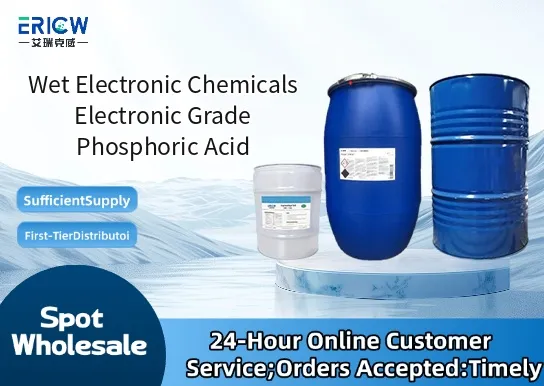
Ultra-high purity with metal impurities <10 ppt (parts per trillion) for sub-28 nm semiconductor process compatibility.
Low particle count (<5 particles/mL @ ≥0.1 µm) ensuring minimal wafer defect generation during wet etching.
Controlled and consistent etch rate uniformity (<±3% across 300 mm wafers) under standard dilution and temperature conditions.
Stabilized formulation with proprietary inhibitors to suppress premature decomposition and maintain shelf life >12 months at ambient storage.
Strict lot-to-lot reproducibility certified via ICP-MS, TOC, and particle analysis per SEMI C37 and C42 standards.
Etchant for silicon nitride (Si₃N₄) removal in front-end-of-line (FEOL) gate stack patterning.
Photoresist stripping and post-etch residue cleaning in advanced logic and memory device fabrication.
Surface conditioning of copper interconnects prior to barrier layer deposition in back-end-of-line (BEOL) processes.
Pre-clean solution for high-k dielectric films (e.g., HfO₂, Al₂O₃) in atomic layer etching (ALE) integration schemes.
Component in mixed-acid formulations for selective oxide-to-nitride etch ratios in 3D NAND and DRAM manufacturing.
| Chemical Type | Orthophosphoric acid (H₃PO₄), electronic grade |
| Product Form | Liquid concentrate (85 wt% aqueous solution) |
| Appearance | Clear, colorless, viscous liquid; no suspended particles or haze |
| Primary Applications | Semiconductor wet etching, cleaning, and surface preparation |
| Key Features | Ultra-low metallic contaminants, low halide content, high thermal stability |
| Benefits | Improved CD control, reduced micro-roughness, enhanced process yield |
| Regulatory Compliance | SEMI C37-1116, SEMI C42-0318, RoHS 2015/863/EU, REACH SVHC-free |
| Packaging | High-purity fluoropolymer-lined HDPE carboys (20 L, 200 L) and ISO tanks |
| Common Compatible Systems | Suitability |
| SEZ Aventos™ Wet Processing Tools | Highly Recommended – Optimized for automated dispense, temperature control, and recirculation |
| Tokyo Electron (TEL) Unity™ i-Line Etch Systems | Highly Recommended – Validated for inline Si₃N₄ etch modules with real-time monitoring |
| Lam Research Versys™ Metal Clean Platforms | Recommended – Compatible with integrated rinse/dry cycles and low-metal fluid paths |
| Screen Semiconductor SFP-3000 Series | Suitable – Requires custom filtration setup (0.02 µm PTFE) and nitrogen blanketing |
Q1: What is the CAS Number for Electronic Grade Phosphoric Acid?
A: The CAS Registry Number is 7664-38-2. All lots are traceable to certified reference materials and accompanied by full analytical certificates.
Q2: What is the recommended working concentration and temperature range for Si₃N₄ etching?
A: Typical working concentration is 65–75 wt% H₃PO₄ diluted with deionized water; optimal temperature range is 155–165 °C. Etch rate is 40–60 Å/min at 160 °C with ±2 °C bath stability.
Q3: How does this electronic grade phosphoric acid differ from industrial or technical grade?
A: Unlike industrial grades, our electronic grade undergoes multi-stage sub-micron filtration, continuous ultra-purification via distillation under inert atmosphere, and rigorous testing for Na, K, Fe, Cu, Ni, Cr, Zn, Al, Ca, Mg, Cl⁻, SO₄²⁻, and NO₃⁻ — all verified below detection limits per ICP-MS.
Q4: Is this product compliant with semiconductor industry migration and leaching requirements for high-aspect-ratio structures?
A: Yes. It meets SEMI F57-0319 requirements for extractables testing (24-hr soak in 18.2 MΩ·cm DI water at 65 °C), with total ion release <0.5 ng/cm² for critical metals and <10 ng/cm² for anions — validated on patterned 3D NAND test wafers.
Contact With Us:
E-mail: wangxingqiang@ericwchem.com
Have a Questions? Call Us:
Add:
Building A1, Jiete Industrial Park, Huangpu District, Guangzhou City, Guangdong Province, China