English
 Español
 tiếng việt
 русский
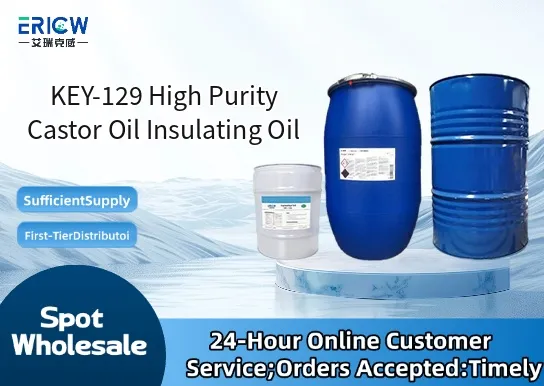
Naturally derived from non-GMO castor beans, offering biobased sustainability without compromising performance.
Ultra-low moisture content (< 50 ppm) and high dielectric strength (>35 kV per ASTM D877), ensuring reliable electrical insulation.
Exceptional oxidative and thermal stability up to 120°C, extending service life in demanding applications.
Free of sulfur, halogens, and metal soaps — eliminates corrosion risk to copper and aluminum components.
Non-toxic formulation compliant with REACH and US EPA Safer Choice criteria for industrial lubricants and dielectrics.
Dielectric fluid in low- to medium-voltage transformers and capacitors requiring natural ester alternatives.
Insulating oil for retrofilling legacy mineral-oil-filled distribution equipment under environmental compliance mandates.
Lubricating and insulating medium in high-precision electromechanical actuators and solenoid systems.
Base fluid in specialty bio-based dielectric greases and gel formulations for aerospace and rail electronics.
Thermal transfer medium in sealed, low-power electronic cooling modules where biodegradability is prioritized.
| Chemical Type | Natural triglyceride (Ricinus communis-derived ricinoleic acid ester) |
| Product Form | Clear, pale yellow liquid at 25°C |
| Appearance | Transparent, slightly viscous liquid; free from sediment or haze |
| Melting Point | −12°C to −8°C (ASTM D938) |
| Primary Applications | Electrical insulation, dielectric fluid, biobased thermal transfer medium |
| Key Features | High dielectric strength, hydrolytic stability, low volatility, renewable origin |
| Benefits | Reduced environmental impact, enhanced fire safety (K-class), compatibility with common elastomers |
| Regulatory Compliance | REACH registered; non-POP, non-PBT; meets EU Directive 2009/128/EC for sustainable use |
| Common Compatible Systems | Suitability |
| Cellulose-based transformer paper (kraft, thermally upgraded) | Highly Recommended – Excellent impregnation and long-term compatibility |
| NBR (nitrile rubber) and EPDM seals & gaskets | Recommended – Minimal swell; validated per ASTM D471 at 72h/100°C |
| Copper and aluminum windings & busbars | Highly Recommended – Non-corrosive; passes ASTM D1275B (copper strip test) |
| Mineral oil–retrofitted distribution transformers (with compatibility assessment) | Suitable – Requires full-flush procedure and post-fill verification per IEEE C57.147 |
Q1: What is the CAS Registry Number for KEY-129?
A: The CAS number for KEY-129 High Purity Castor Oil Insulating Oil is 8001-79-4 (refers to refined, dehydrated castor oil meeting IEC 62770 specification).
Q2: Can KEY-129 be used directly as a drop-in replacement for mineral insulating oil?
A: Not without system evaluation. KEY-129 is fully miscible but requires thorough flushing, moisture removal, and post-fill testing (dielectric strength, acidity, DGA) per IEEE C57.147 before energization.
Q3: How does KEY-129 compare to synthetic esters (e.g., TMP trioleate) in terms of oxidation resistance?
A: KEY-129 exhibits superior hydrolytic stability and lower volatility than many synthetic esters, though its oxidation onset temperature is ~15°C lower; antioxidant additives (e.g., BHT) are pre-blended to meet IEC 62770 Class II requirements.
Q4: Is KEY-129 subject to FDA food-contact or pharmaceutical-grade certification?
A: No. KEY-129 is formulated and tested exclusively for industrial electrical insulation. It is not certified under FDA 21 CFR or USP standards and must not be used in food, drug, or cosmetic manufacturing environments.
Contact With Us:
E-mail: wangxingqiang@ericwchem.com
Have a Questions? Call Us:
Add:
Building A1, Jiete Industrial Park, Huangpu District, Guangzhou City, Guangdong Province, China