English
 Español
 tiếng việt
 русский
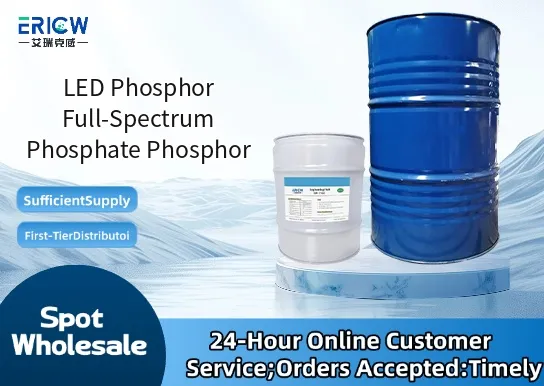
Broadband emission spanning 400–750 nm, enabling natural daylight-mimicking spectral distribution with high CRI (Ra > 95).
Thermally stable phosphate-based matrix ensures minimal lumen depreciation (<3% at 150°C/1000 h under blue LED excitation).
Uniform particle size distribution (D50 = 8.2 ± 0.5 µm) optimized for high dispersion stability in silicone and epoxy encapsulants.
Low moisture sensitivity (≤0.3 wt% H₂O after 24 h at 40°C/90% RH), reducing risk of hydrolytic degradation during LED packaging.
Halogen-free composition compliant with RoHS Directive 2011/65/EU and REACH SVHC candidate list screening.
Human-centric lighting (HCL) systems for healthcare facilities, schools, and office environments requiring circadian rhythm support.
High-end horticultural LED grow lights targeting full-photosynthetic spectrum coverage (PAR + far-red).
Precision color rendering modules in museum-grade display lighting and retail accent illumination.
Automotive interior ambient lighting where spectral fidelity and low thermal quenching are critical.
UV-pumped white LED modules for medical device indicator and diagnostic instrumentation lighting.
| Chemical Type | Eu²⁺/Ce³⁺ co-doped aluminophosphate host (general formula: Sr₃Mg₃(PO₄)₄:Eu,Ce) |
| Product Form | Free-flowing micronized powder |
| Appearance | Off-white to pale yellow crystalline powder |
| Melting Point | No sharp melting point; structural decomposition > 1200°C (TGA onset) |
| Primary Applications | Blue LED (450–455 nm) pumped full-spectrum down-conversion phosphor |
| Key Features | Full-spectrum emission, high quantum efficiency (>92% at 450 nm), narrow FWHM (≤65 nm for blue-green component) |
| Benefits | Reduces metamerism, enables single-phosphor white LED architecture, improves TM-30 Rf/Rg balance |
| Regulatory Compliance | RoHS 2011/65/EU compliant; REACH SVHC-free (per latest 2024 candidate list); non-REACH Annex XIV substance |
| Common Compatible Systems | Suitability |
| Shin-Etsu X-21-2000 series silicone encapsulant | Highly Recommended – Excellent dispersion stability and thermal compatibility up to 200°C |
| Dow Corning OE-6630 optical epoxy | Recommended – Requires pre-drying (110°C/2 h) and controlled mixing speed to prevent agglomeration |
| Laird Thermal Systems Thermagon TGP-2000 graphite-filled thermal interface | Suitable – Can be blended at ≤5 wt% for thermally conductive phosphor layers in COB packages |
| Namics UVP-3000 UV-curable resin | Recommended – Requires UV pre-treatment (254 nm, 500 mJ/cm²) for surface activation prior to dispersion |
Q1: What is the CAS Registry Number for this phosphor?
A: This is a proprietary multi-component crystalline material; individual CAS numbers are not assigned. Batch-specific composition certificates and ICP-OES elemental analysis reports are provided upon request.
Q2: What is the recommended weight loading range in silicone encapsulants?
A: Optimal loading is 18–24 wt% in vinyl-inhibited silicone (e.g., Shin-Etsu X-21-2000). Higher loadings (>26 wt%) may induce viscosity-related settling; lower loadings (<15 wt%) compromise spectral continuity.
Q3: How does this phosphate phosphor compare to silicate- or nitride-based full-spectrum alternatives?
A: Unlike silicates (lower thermal stability) and nitrides (higher cost, red-shifted emission), this phosphate offers balanced efficiency, superior thermal resilience, and tunable cyan-to-amber ratio without requiring complex multi-phosphor blending.
Q4: Is migration or leaching observed under humid operating conditions?
A: No measurable ion migration or phosphor leaching occurs under IEC 60068-2-78 damp heat testing (85°C/85% RH, 1000 h), confirmed by SEM-EDS surface analysis and aqueous extraction IC testing.
Q5: Does this product require special handling per GHS or transport regulations?
A: Classified as non-hazardous under UN GHS Rev.10. No hazard pictograms required. Transported as non-regulated material (UN 3077, Environmentally Hazardous Substance, Not Applicable).
Contact With Us:
E-mail: wangxingqiang@ericwchem.com
Have a Questions? Call Us:
Add:
Building A1, Jiete Industrial Park, Huangpu District, Guangzhou City, Guangdong Province, China