English
 Español
 tiếng việt
 русский
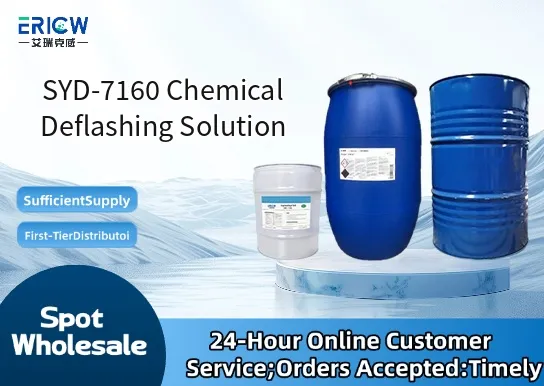
Non-corrosive to common engineering plastics and metal tooling, ensuring part integrity and extended equipment life.
Fast-acting deflashing performance at ambient to mild elevated temperatures (20–45 °C), reducing cycle time versus thermal or mechanical methods.
Low-volatility, water-miscible formulation with negligible VOC emissions, supporting safer workplace handling and EHS compliance.
pH-stabilized chemistry (pH 8.2–9.0) minimizes hydrolysis risk for sensitive elastomers and thermoplastic vulcanizates (TPVs).
Biodegradable base components aligned with OECD 301B screening criteria, facilitating sustainable waste stream management.
Deflashing silicone rubber (LSR, HCR) molded gaskets, seals, and medical tubing components.
Cleaning flash from thermoplastic elastomer (TPE-TPO, TPE-SEBS) automotive interior parts.
Post-mold deburring of polyurethane (PU) bushings, rollers, and industrial castings.
Surface refinement of fluorosilicone and FKM-based aerospace O-rings prior to functional testing.
Batch immersion deflashing for small-diameter precision plastic connectors in electronics assembly.
| Chemical Type | Aqueous alkaline blend with selective organic activators |
| Product Form | Liquid concentrate (ready-to-dilute) |
| Appearance | Clear, pale amber liquid, free of sediment |
| Specific Gravity (25 °C) | 1.08 ± 0.02 |
| pH (1% aqueous solution, 25 °C) | 8.6 ± 0.3 |
| Primary Applications | Chemical deflashing of elastomers and thermoplastics |
| Key Features | Non-oxidizing, non-acidic, low-foaming, non-hazardous per GHS Category 4 |
| Regulatory Compliance | REACH compliant; RoHS 2015/863 Annex II confirmed; no SVHCs above 0.1% w/w |
| Common Compatible Systems | Suitability |
| Ultrasonic immersion tanks (stainless steel 316) | Highly Recommended – No corrosion observed after 12-month continuous use |
| Recirculating spray wash systems (PP/PVDF piping) | Recommended – Requires inline filtration <50 µm to retain suspended flash particulates |
| Batch dip tanks (polypropylene or fiberglass-reinforced plastic) | Highly Recommended – Chemically inert; no stress cracking observed |
| Robotic part-handling immersion lines | Suitable – Compatible with standard EPDM and Viton® gripper seals |
Q1: What is the CAS Registry Number for SYD-7160?
A: SYD-7160 is a proprietary multi-component formulation; individual constituents are disclosed under full material safety data sheet (MSDS), but the mixture itself does not carry a single CAS number per IUPAC guidelines.
Q2: What is the recommended working concentration and typical dwell time?
A: Dilute 1:10 to 1:20 v/v with deionized water; optimal dwell time ranges from 5–25 minutes depending on flash thickness and substrate—validated via ASTM D471 soak testing.
Q3: How does SYD-7160 compare to acidic or solvent-based deflashers in terms of material compatibility?
A: Unlike strong-acid (e.g., HF-based) or chlorinated-solvent alternatives, SYD-7160 avoids etching, swelling, or plasticizer extraction in sensitive polymers such as TPU, TPE-E, and medical-grade silicones.
Q4: Has SYD-7160 been tested for extractables and leachables per USP <87> and <88>?
A: Yes—certified biocompatibility test reports confirm <0.5 µg/cm² total organic extractables (TOE) on cured LSR after 72-hr extraction at 50 °C, meeting Class VI requirements.
Q5: Is SYD-7160 approved for use in food-contact or pharmaceutical manufacturing environments?
A: SYD-7160 is NSF/ANSI Standard 60 certified for incidental contact with drinking water system components; full food-contact approval (FDA 21 CFR 175.300) applies only to post-rinse validated processes with residual limits ≤10 ppm.
Contact With Us:
E-mail: wangxingqiang@ericwchem.com
Have a Questions? Call Us:
Add:
Building A1, Jiete Industrial Park, Huangpu District, Guangzhou City, Guangdong Province, China