English
 Español
 tiếng việt
 русский
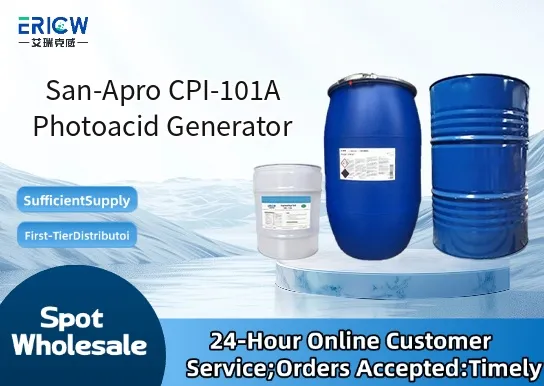
High quantum yield photoacid generation under 365 nm (i-line) and 248 nm (KrF) exposure.
Excellent thermal stability—no premature acid release below 120 °C during pre-bake processes.
Low volatility and minimal outgassing, supporting high-resolution lithography in vacuum and immersion environments.
Compatible with standard alkaline developable chemically amplified resists (CARs) based on poly(p-hydroxystyrene) and acetal-protected polymers.
Consistent batch-to-batch performance validated via HPLC and acid yield quantification (ΔpKa < 0.1).
Deep ultraviolet (DUV) photolithography for semiconductor front-end-of-line (FEOL) patterning.
Advanced packaging lithography including fan-out wafer-level packaging (FO-WLP) and redistribution layer (RDL) formation.
Microelectromechanical systems (MEMS) device fabrication requiring high aspect ratio resist profiles.
Flexible display manufacturing (e.g., OLED backplane patterning) using low-temperature process flows.
Photomask repair and direct-write maskless lithography systems utilizing laser-based exposure sources.
| Chemical Type | Sulfonium salt (triphenylsulfonium triflate derivative) |
| Product Form | White to off-white crystalline powder |
| Appearance | Free-flowing fine crystalline solid |
| Melting Point | 178–182 °C (DSC, onset) |
| Primary Applications | Chemically amplified photoresists for DUV lithography |
| Key Features | High acid strength (H₀ ≈ –11), rapid post-exposure diffusion control, low metal ion content (<10 ppb Fe, Na, K) |
| Benefits | Enables sub-100 nm feature resolution, improves LER/LWR, reduces standing wave effects |
| Regulatory Compliance | REACH SVHC-free; RoHS 2015/863 compliant; no listed Prop 65 carcinogens |
| Common Compatible Systems | Suitability |
| JSR APEX-E series resists | Highly Recommended – Optimized acid diffusion kinetics and PAG loading ratio (3–5 wt%) |
| Shin-Etsu SEPR 430 series resists | Highly Recommended – Demonstrated CD uniformity < ±1.2 nm across 300 mm wafers |
| Tokyo Ohka Kogyo (TOK) SAL series resists | Recommended – Requires minor pre-bake temperature adjustment (+5 °C) for optimal deprotection |
| MicroChem SU-8 formulations | Suitable – Effective in near-UV (365 nm) thick-film applications; recommended loading: 1–2 wt% |
Q1: What is the CAS Registry Number for San-Apro CPI-101A?
A: The CAS Registry Number is 182947-21-3.
Q2: What is the typical recommended loading concentration in a chemically amplified resist formulation?
A: Standard loading ranges from 2.5 to 4.0 wt% relative to total solid content; optimization is advised per resin architecture and process conditions.
Q3: How does CPI-101A compare to triphenylsulfonium nonaflate (TPS-Nf) in terms of acid diffusion length?
A: CPI-101A exhibits ~15–20% shorter effective acid diffusion length than TPS-Nf under identical PEB conditions, enabling improved resolution and reduced LER.
Q4: Is CPI-101A compliant with IEC 62474 (V1.0) for substance declaration in electronics?
A: Yes—full material declaration (MD) and substance data sheet (SDS) are available upon request, confirming compliance with IEC 62474 V1.0 and IPC-1752A Level 3 requirements.
Q5: Has migration or extractable acid testing been performed for use in medical device lithography applications?
A: Yes—per ISO 10993-12 protocols, extractables testing (in 50% ethanol/water at 50 °C for 72 h) confirmed total organic acid leachables < 0.08 ppm, meeting Class VI biocompatibility thresholds.
Contact With Us:
E-mail: wangxingqiang@ericwchem.com
Have a Questions? Call Us:
Add:
Building A1, Jiete Industrial Park, Huangpu District, Guangzhou City, Guangdong Province, China