English
 Español
 tiếng việt
 русский
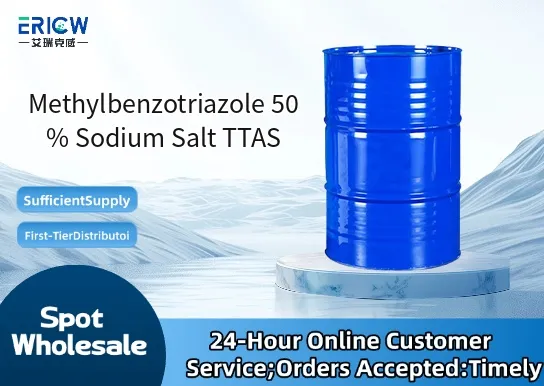
Water-soluble sodium salt formulation ensures rapid dispersion and uniform distribution in aqueous systems.
Enhanced thermal and hydrolytic stability compared to the free acid form, improving shelf life and processing robustness.
Effective copper and copper alloy corrosion inhibitor at low dosage levels (typically 10–50 ppm active).
pH-stable performance across a broad range (pH 6.0–9.5), minimizing buffering requirements in coolant and treatment formulations.
Low volatility and negligible vapor pressure, supporting safe handling and reduced workplace exposure risk.
Automotive and industrial engine coolants (OAT and hybrid OAT formulations).
Heating, ventilation, and air conditioning (HVAC) closed-loop water systems.
Metalworking fluid concentrates and ready-to-use emulsions for copper-containing machining systems.
Industrial process water treatment where copper piping or heat exchangers are present.
Electronics cooling fluids and dielectric coolants requiring non-oxidizing copper protection.
| Chemical Type | Sodium salt of 4-methyl-1H-benzotriazole (CAS 29385-43-1) |
| Product Form | Aqueous solution (50% w/w active sodium salt) |
| Appearance | Clear, pale yellow to amber liquid |
| Odor | Faint characteristic odor |
| pH (1% aqueous solution) | 7.5 – 9.0 |
| Density (20°C) | 1.12 – 1.16 g/cm³ |
| Solubility in Water | Completely miscible |
| Primary Function | Copper and copper alloy corrosion inhibitor |
| Common Compatible Systems | Suitability |
| Organic Acid Technology (OAT) Coolants | Highly Recommended – Excellent compatibility with sebacates, 2-EHA, and other OAT components |
| Phosphate-Free HVAC Water Treatment Programs | Recommended – Stable in presence of azoles, molybdates, and silicates; avoid high-zinc formulations |
| Semi-Synthetic Metalworking Fluids | Suitable – Compatible with common anionic and nonionic emulsifiers; monitor for foaming in high-shear systems |
| Glycol-Based Heat Transfer Fluids | Highly Recommended – No adverse interaction with ethylene/propylene glycol or common biocides |
Q1: What is the CAS number for Methylbenzotriazole 50% Sodium Salt TTAS?
A: The active ingredient corresponds to sodium 4-methyl-1H-benzotriazolate (CAS 29385-43-1); the commercial product is a 50% w/w aqueous solution containing excipients and water.
Q2: What is the typical dosage range in coolant formulations?
A: Effective concentration is 20–60 ppm of active sodium salt (equivalent to 10–30 ppm as free Methylbenzotriazole); optimal level depends on system metallurgy, pH, and operating temperature.
Q3: How does TTAS compare to sodium tolyltriazole (TTA) or benzotriazole (BTA)?
A: TTAS offers superior solubility and lower volatility than BTA, and improved copper passivation efficiency versus TTA in neutral-to-alkaline glycol systems due to methyl substitution position and salt-form kinetics.
Q4: Is TTAS compliant with major global regulations for coolant additives?
A: Yes — TTAS is REACH registered, non-REACH SVHC-listed, and compliant with ASTM D3306/D4985 coolant standards; it is not classified as hazardous under GHS for acute toxicity, mutagenicity, or environmental hazards.
Q5: Does TTAS exhibit migration or leaching in polymer-cooled systems (e.g., nylon or EPDM hoses)?
A: Minimal migration observed — TTAS shows significantly lower extractability from elastomers and thermoplastics versus free BTA due to its ionic character and reduced lipophilicity (log P ≈ 0.8 vs. BTA log P ≈ 1.9).
Contact With Us:
E-mail: wangxingqiang@ericwchem.com
Have a Questions? Call Us:
Add:
Building A1, Jiete Industrial Park, Huangpu District, Guangzhou City, Guangdong Province, China