English
 Español
 tiếng việt
 русский
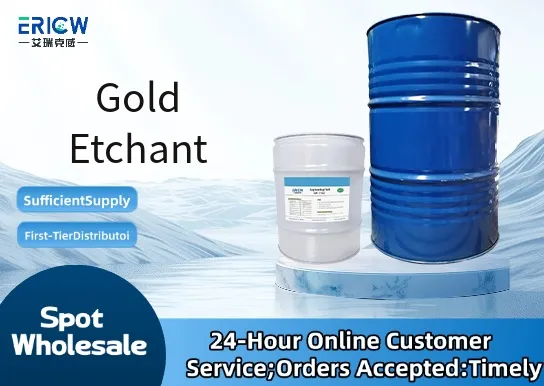
Precisely controlled etch rate for high-resolution gold patterning on microelectronic substrates.
Non-cyanide, iodine-based formulation ensuring improved workplace safety and reduced environmental hazard.
Excellent selectivity over common masking layers including photoresist, nickel, chromium, and titanium.
Stable at room temperature with extended shelf life (>12 months unopened under recommended storage).
Low metal ion contamination profile, meeting stringent requirements for semiconductor and MEMS fabrication.
Fabrication of RF/microwave components and high-frequency interconnects in advanced packaging.
Microstructuring of gold electrodes in biosensors, lab-on-chip devices, and electrochemical platforms.
Pattern definition in flexible printed electronics and transparent conductive film manufacturing.
Release etching and trimming of gold traces during MEMS device post-processing.
Repair and rework of fine-pitch gold circuitry in aerospace and defense-grade PCB assemblies.
| Chemical Type | Iodine–potassium iodide (I₂–KI) aqueous solution |
| Product Form | Liquid concentrate (ready-to-dilute) |
| Appearance | Clear to pale amber liquid; no sediment or cloudiness |
| pH (1:10 dilution) | 6.8 – 7.4 (neutral to slightly alkaline) |
| Primary Applications | Wet etching of thin-film gold (10 nm – 5 µm) on Si, SiO₂, glass, and polymer substrates |
| Key Features | Non-oxidizing, low-corrosion to underlying adhesion layers (e.g., Ti, Cr, NiV) |
| Benefits | Consistent uniformity, minimal undercut (<0.5 µm), compatible with automated dispensing systems |
| Regulatory Compliance | REACH compliant; RoHS 2015/863 Annex II conformant; SDS available per GHS Rev. 10 |
| Common Compatible Systems | Suitability |
| Standard photolithography process lines (manual & semi-automated) | Highly Recommended – Fully compatible with spin-coaters, spray developers, and immersion etch tanks |
| Wafer-level batch processing tools (e.g., Modutek, Technics) | Recommended – Requires minor parameter tuning for flow rate and dwell time |
| Desktop microfluidic etching stations (e.g., SSEC, VCT) | Suitable – Validated for use with precision syringe pumps and PTFE fluidic paths |
| Ultrasonic cleaning & etch integration systems | Suitable – Effective under low-power ultrasonication (≤40 kHz, <100 W); avoid prolonged exposure |
Q1: What is the CAS Registry Number for Gold Etchant?
A: The primary active system is registered under CAS No. 7553-56-2 (Iodine) and 7681-11-0 (Potassium Iodide); full formulation is proprietary and assigned internal product ID GE-2024-01.
Q2: What is the recommended working concentration and typical etch rate?
A: Dilute 1 part concentrate with 9 parts deionized water (1:10 v/v) for standard use; etch rate ranges from 15–30 nm/s at 22 °C on 200 nm Au/Ti films, adjustable via temperature and agitation control.
Q3: How does this Gold Etchant compare to traditional cyanide-based etchants?
A: Unlike cyanide etchants, this formulation eliminates acute toxicity risks, simplifies wastewater treatment, and avoids passivation issues—while delivering comparable resolution and edge acuity for sub-micron features.
Q4: Is Gold Etchant certified for use in medical device manufacturing?
A: Yes — it meets ISO 10993-12 extractables testing requirements for short-term contact devices; full biocompatibility documentation and CoA are provided upon order confirmation.
Q5: Does Gold Etchant cause metal migration or ion extraction in multi-layer stacks?
A: No significant migration observed under standard process conditions; validated via TOF-SIMS and EDX analysis on Au/Ni/Cu/SiO₂/Si stacks — residual iodide levels remain below 5 ppm after DI rinse and N₂ dry.
Contact With Us:
E-mail: wangxingqiang@ericwchem.com
Have a Questions? Call Us:
Add:
Building A1, Jiete Industrial Park, Huangpu District, Guangzhou City, Guangdong Province, China