English
 Español
 tiếng việt
 русский
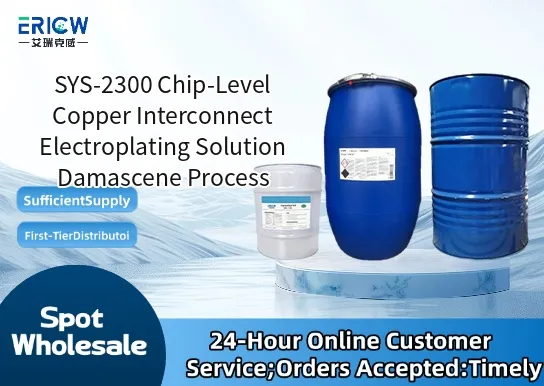
Ultra-low additive concentration enables exceptional superfilling performance with minimal void formation in sub-45 nm dual-damascene trenches and vias.
Proprietary suppressor and accelerator chemistry delivers robust process window stability across variable current densities (1–10 mA/cm²) and wafer geometries.
Formulated for compatibility with standard SPM (sulfuric acid–peroxide mixture) and dilute SC-1 cleaning, minimizing post-plating residue and interfacial defects.
Reduced copper ion depletion rate extends bath life beyond 5 MAF (metal addition factor) under continuous replenishment control.
Non-cyanide, sulfate-based electrolyte system compliant with semiconductor fab environmental health & safety (EHS) requirements.
Front-end-of-line (FEOL) copper interconnect metallization for logic and memory ICs at 7 nm to 28 nm technology nodes.
Advanced packaging applications including fan-out wafer-level packaging (FOWLP) redistribution layer (RDL) copper plating.
High-bandwidth memory (HBM) stack interposer via filling with aspect ratios >8:1.
RF and millimeter-wave SoC interconnects requiring low-resistivity, high-purity copper films (<0.18 µΩ·cm).
Chiplet integration platforms where uniform step coverage and low surface roughness (<1.2 nm RMS) are critical.
| Chemical Type | Aqueous acidic copper sulfate electrolyte with proprietary organic additives |
| Product Form | Liquid concentrate (ready-to-dilute) |
| Appearance | Clear, light amber solution; no visible particulates or phase separation |
| pH (as supplied, 25°C) | 0.7–1.1 |
| Copper Ion Concentration (as supplied) | 45–55 g/L Cu²⁺ |
| Primary Applications | Dual-damascene copper electroplating for advanced semiconductor interconnects |
| Key Features | Superconformal bottom-up fill, low defect density, excellent throwing power (>90% at 10 µm depth) |
| Regulatory Compliance | REACH SVHC-free; RoHS 2011/65/EU compliant; no listed TSCA Confidential Business Information (CBI) components |
| Common Compatible Systems | Suitability |
| Applied Materials SABRE® XP Platform | Highly Recommended – Validated for full-process integration with integrated wet clean and anneal modules |
| Lam Research Altus® Max System | Highly Recommended – Optimized for multi-step pulse-reverse plating with real-time bath monitoring interface |
| Screen Semiconductor Solutions FLEXY Series | Recommended – Requires minor anode basket geometry adjustment for optimal mass transport control |
| Tokyo Electron Ultera® ECP Tool | Suitable – Compatible with standard consumables; bath temperature control setpoint ±0.3°C recommended |
Q1: What is the CAS Registry Number for SYS-2300?
A: SYS-2300 is a proprietary multi-component formulation; individual CAS numbers are assigned only to disclosed non-confidential constituents per SDS Section 3. Full formulation CAS is not assigned per industry practice for trade-secret electroplating chemistries.
Q2: What is the typical working concentration and replenishment rate during production?
A: Diluted working bath: 20–25 mL/L SYS-2300 concentrate in deionized water + 50–60 g/L CuSO₄·5H₂O + 50–60 mL/L H₂SO₄ (96%). Replenishment: 1.2–1.8 mL/L per 100 C/L of charge passed, controlled via CV or amperometric titration.
Q3: How does SYS-2300 compare to legacy copper plating chemistries in terms of migration risk under bias-temperature stress?
A: SYS-2300 exhibits <5% copper migration after 1000 h at 125°C/3 V bias (tested per JEDEC JESD22-A108), significantly lower than conventional PEG/Cl⁻-based systems due to its stabilized suppressor adsorption layer and reduced chloride content (<10 ppm).
Q4: Is SYS-2300 certified for use in ISO 14644-1 Class 1 cleanrooms?
A: Yes — SYS-2300 is manufactured and filtered to ≤0.05 µm particle count (per IEST-G-CC1002) and validated for Class 1 (ISO 3) compatibility when handled using Class 1-certified dispensing systems and nitrogen-purged storage.
Contact With Us:
E-mail: wangxingqiang@ericwchem.com
Have a Questions? Call Us:
Add:
Building A1, Jiete Industrial Park, Huangpu District, Guangzhou City, Guangdong Province, China