English
 Español
 tiếng việt
 русский
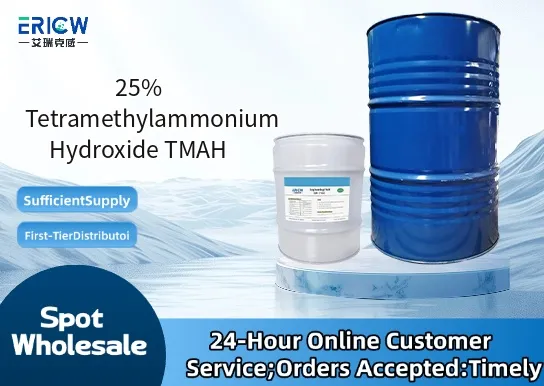
Highly selective and isotropic etchant for silicon dioxide and silicon nitride in microfabrication processes.
Low metal ion content (<1 ppb Na, K, Fe, Cu) ensuring minimal contamination in semiconductor cleanroom environments.
Excellent thermal and chemical stability at room temperature with consistent performance across batch-to-batch manufacturing.
Non-oxidizing alkaline developer compatible with photolithographic resists including novolac and chemically amplified types.
Readily miscible with deionized water and standard organic solvents used in wafer cleaning formulations.
Semiconductor photomask development and pattern transfer in MEMS and IC fabrication.
Etching of silicon wafers for MEMS device structuring (e.g., cantilevers, diaphragms, microchannels).
Photoresist stripping and post-etch residue removal in advanced packaging lines.
Surface modification and hydrophilization of silicon and quartz substrates prior to bonding or coating.
Electrochemical sensor electrode conditioning and functionalization in analytical instrumentation.
| Chemical Type | Quaternary ammonium hydroxide |
| Product Form | Aqueous solution (25 wt% TMAH in H₂O) |
| Appearance | Clear, colorless liquid |
| pH (25°C, 1% aqueous) | ≥13.2 |
| Density (25°C) | 1.07–1.09 g/cm³ |
| Primary Applications | Photolithography development, silicon etching, wafer cleaning |
| Key Features | Low volatility, non-volatile cation, minimal residue after evaporation |
| Regulatory Compliance | REACH registered; SDS available per GHS Rev. 8; not classified as PBT/vPvB |
| Common Compatible Systems | Suitability |
| Standard spin coater & developer track (e.g., Tokyo Electron CLEAN TRACK) | Highly Recommended – Fully validated for resist development at 23–25°C |
| Batch-type silicon etch systems (e.g., SEMI-compliant wet benches) | Highly Recommended – Stable performance up to 90°C with controlled etch rate uniformity |
| DI water rinse and megasonic cleaning modules | Recommended – Low surface tension enables efficient residue removal without redeposition |
| Stainless steel (316L) and fluoropolymer (PTFE, PFA) fluidic components | Suitable – No corrosion observed under continuous recirculation at ≤40°C |
Q1: What is the CAS Number for 25% Tetramethylammonium Hydroxide?
A: The CAS Number for tetramethylammonium hydroxide monohydrate (common commercial form) is 75-59-2; the anhydrous base is 10424-56-1. Our 25% aqueous solution is supplied as the monohydrate-equivalent formulation.
Q2: What is the typical working concentration range for silicon etching applications?
A: For anisotropic silicon etching, concentrations are typically diluted to 5–15% (w/w) with deionized water; undiluted 25% solution is recommended for high-resolution photodevelopment where fast dissolution kinetics are required.
Q3: How does 25% TMAH compare to KOH or NaOH in terms of safety and process control?
A: Unlike KOH/NaOH, TMAH contains a non-volatile, thermally stable cation that eliminates hazardous fumes and reduces operator exposure risk. Its etch rate is highly temperature-dependent but more reproducible than alkali metal hydroxides due to negligible carbonate formation and lower sensitivity to atmospheric CO₂.
Q4: Does 25% TMAH meet USP/EP requirements for use in pharmaceutical device manufacturing?
A: While not pharmacopoeial-grade, our product meets ASTM D5127-22 purity criteria for electronic-grade reagents and is widely accepted in Class 100 cleanrooms for medical microdevice fabrication; full traceability and lot-specific CoA are provided.
Q5: Is there risk of TMA⁺ ion migration into polymer substrates during processing?
A: Migration is negligible in short-duration (<5 min), room-temperature exposures typical for lithography. For prolonged contact (>10 min) with hydrophilic polymers (e.g., polyimide, SU-8), rinsing with DI water immediately post-development effectively prevents residual cation entrapment.
Contact With Us:
E-mail: wangxingqiang@ericwchem.com
Have a Questions? Call Us:
Add:
Building A1, Jiete Industrial Park, Huangpu District, Guangzhou City, Guangdong Province, China