English
 Español
 tiếng việt
 русский
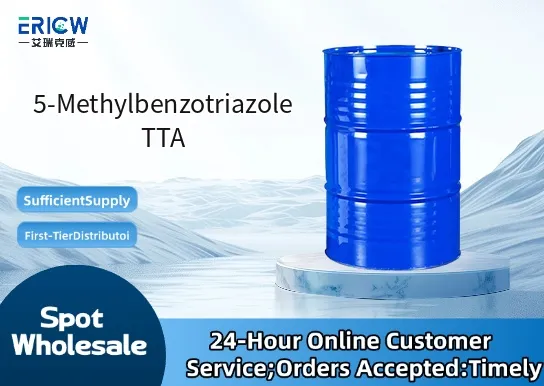
Highly effective copper corrosion inhibitor with superior thermal and hydrolytic stability.
Low volatility and excellent persistence in recirculating cooling water and heat transfer fluids.
Compatible with common scale inhibitors, dispersants, and biocides in formulated treatment programs.
Non-oxidizing mechanism preserves system metallurgy without promoting pitting or stress corrosion cracking.
Eco-friendly alternative to benzotriazole (BTA), offering reduced aquatic toxicity profile.
Cooling water systems in power generation, HVAC, and industrial process plants.
Antifreeze and engine coolant formulations for automotive and heavy-duty applications.
Heat transfer fluids in solar thermal and closed-loop industrial heating/cooling circuits.
Latex emulsion polymerization stabilizers and metalworking fluid additives.
Protective coatings and primers for copper-containing alloys in marine and architectural environments.
| Chemical Type | Heterocyclic organic corrosion inhibitor (substituted benzotriazole) |
| Product Form | Free-flowing off-white to pale tan crystalline powder |
| Appearance | Crystalline solid, no visible foreign matter |
| Melting Point | 84–87 °C (determined by DSC, USP <741>) |
| Assay (HPLC) | ≥ 98.5% (on anhydrous basis) |
| Primary Applications | Copper and copper-alloy corrosion protection in aqueous systems |
| Key Features | Non-volatile, low water solubility (~0.3 g/L at 25 °C), pH-stable (4–10) |
| Regulatory Compliance | REACH registered; not classified as CMR or PBT under EU CLP Regulation |
| Common Compatible Systems | Suitability |
| Phosphate-based cooling water treatment programs | Highly Recommended – Synergistic inhibition performance with zinc and phosphonates |
| Glycol/water heat transfer fluids (ethylene & propylene glycol) | Recommended – Stable up to 130 °C; minimal degradation over 12-month service life |
| Non-oxidizing biocide blends (e.g., isothiazolinones, DBNPA) | Suitable – No adverse interaction observed in compatibility screening studies |
| Polyacrylate/polymer dispersant systems | Highly Recommended – Enhances dispersion of protective inhibitor films on copper surfaces |
Q1: What is the CAS Number for 5-Methylbenzotriazole TTA?
A: The CAS Registry Number is 3934-65-6.
Q2: What is the typical dosage range in cooling water systems?
A: Standard dosage is 2–10 ppm (as active) in circulating cooling water; optimal concentration depends on copper surface area, pH, and oxidant presence—field trials recommended for system-specific tuning.
Q3: How does 5-Methylbenzotriazole TTA compare to standard benzotriazole (BTA)?
A: The 5-methyl substitution enhances lipophilicity and film-forming durability on copper surfaces, improves resistance to chlorine oxidation, and reduces leaching rates in high-flow systems versus unsubstituted BTA.
Q4: Is it compliant with EU Biocidal Products Regulation (BPR) for use as a preservative?
A: It is not approved as an active biocidal substance under BPR Annex I; however, its use as a corrosion inhibitor in treated articles (e.g., coolants, coatings) falls under Article 3(1)(j) exemptions when not intended for biocidal action.
Q5: Does it migrate from polymer matrices or coatings into aqueous media?
A: Migration is minimal under static conditions (<0.1 ppm after 30 days in deionized water at 25 °C); elevated temperature (>60 °C) or aggressive solvents (e.g., THF, DMF) increase extractability—formulation testing advised for regulatory submissions.
Contact With Us:
E-mail: wangxingqiang@ericwchem.com
Have a Questions? Call Us:
Add:
Building A1, Jiete Industrial Park, Huangpu District, Guangzhou City, Guangdong Province, China