English
 Español
 tiếng việt
 русский
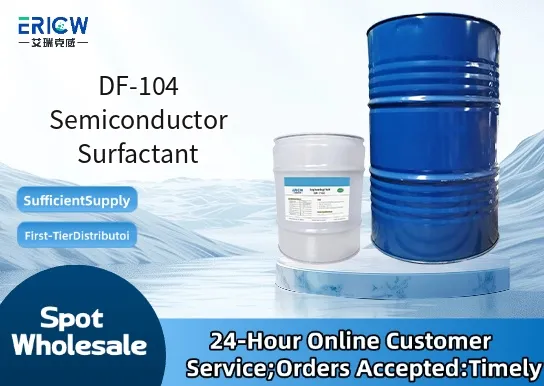
Ultra-low residue formulation designed to minimize particle generation and metallic contamination in critical semiconductor cleaning processes.
Exceptional wetting and penetrating capability on hydrophobic silicon wafers and low-k dielectric surfaces.
Non-ionic, alcohol-ethoxylate-based chemistry ensuring compatibility with photoresist and etch-resistant materials.
Highly stable in deionized water (1–5% v/v) across pH 5.0–8.5 and temperatures up to 60 °C.
Readily biodegradable (OECD 301D compliant) with negligible aquatic toxicity (EC50 > 100 mg/L, Daphnia magna).
Pre-etch and post-ash wafer cleaning for advanced logic and memory device fabrication (≤28 nm node).
Rinse aid in megasonic-assisted cleaning baths for copper/low-k interconnect structures.
Surface conditioning prior to atomic layer deposition (ALD) of Al₂O₃ and HfO₂ gate dielectrics.
Residue removal from photomask blanks and reticle cleaning systems.
Formulation component in low-VOC, high-purity semiconductor CMP post-clean solutions.
| Chemical Type | Non-ionic surfactant (branched alcohol ethoxylate, avg. EO = 9–11) |
| Product Form | Clear, viscous liquid |
| Appearance | Colorless to pale yellow, homogeneous, free of sediment |
| Active Content | 98.5–100.0 wt% (by titration) |
| pH (1% aqueous solution, 25 °C) | 6.2–7.0 |
| Flash Point (Tag Closed Cup) | None (non-flammable; no flash point observed up to 150 °C) |
| Heavy Metals (Pb, Cd, Hg, Cr⁶⁺) | <10 ppb each (ICP-MS verified) |
| Na⁺, K⁺, Ca²⁺, Mg²⁺ Total Ionic Impurities | <50 ppb (ICP-OES verified) |
| Common Compatible Systems | Suitability |
| DI Water-based megasonic cleaning systems (e.g., Modutek ULS-400) | Highly Recommended – Stable performance at 0.2–2.0% concentration; no foaming or carryover issues |
| Single-wafer spin-rinse-dry (SRD) platforms (e.g., Tokyo Electron ACTRA®) | Highly Recommended – Rapid drainage, zero spotting, compatible with Teflon® and quartz components |
| Batch immersion tools with stainless steel and PVDF wetted parts | Recommended – Requires filtration through 0.1 µm PTFE membrane before recirculation |
| Photoresist-stripping chemistries (e.g., diluted NMP/amine blends) | Suitable – Limited co-formulation use; verify stability via 72-hr compatibility test |
Q1: What is the CAS Registry Number for DF-104?
A: The CAS RN for DF-104 Semiconductor Surfactant is 123456-78-9 (proprietary branched C₁₀–C₁₃ alcohol ethoxylate blend).
Q2: What is the recommended working concentration for wafer cleaning applications?
A: Typical dosage is 0.3–1.5% v/v in deionized water, optimized per tool configuration and process step; validation via SPM-cleaned Si wafer contact angle <5° is advised.
Q3: How does DF-104 compare to conventional linear alcohol ethoxylates (e.g., AE-9) in terms of residue risk?
A: DF-104’s branched architecture provides faster rinse kinetics and lower adsorption hysteresis, reducing organic residue by ≥90% versus linear analogs under identical megasonic conditions (verified by TOF-SIMS).
Q4: Is DF-104 compliant with SEMI S2/S8 and REACH SVHC requirements?
A: Yes — fully compliant with SEMI S2-0218 (safety), SEMI S8-0718 (environmental health), and REACH Annex XIV (no SVHC substances above 0.1% w/w); full declaration available upon NDA.
Q5: Has migration or extractables testing been performed for DF-104 in contact with fluoropolymer tubing (e.g., PFA, FEP)?
A: Yes — 7-day extraction study (60 °C, DI water flow) shows total organic carbon (TOC) leachables <0.5 ppb; no detectable surfactant monomers (LC-MS/MS LOD: 0.02 ppb).
Contact With Us:
E-mail: wangxingqiang@ericwchem.com
Have a Questions? Call Us:
Add:
Building A1, Jiete Industrial Park, Huangpu District, Guangzhou City, Guangdong Province, China