English
 Español
 tiếng việt
 русский
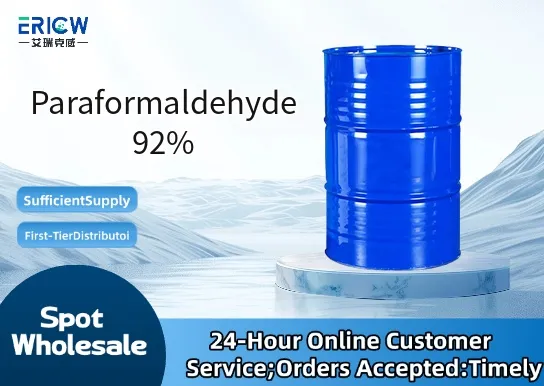
High-purity polymerized formaldehyde with consistent 92% minimum assay, ensuring reliable reactivity in synthesis and crosslinking.
Low residual free formaldehyde (<0.5%), enhancing workplace safety and reducing odor and volatility concerns.
Excellent thermal stability and controlled depolymerization profile—releases formaldehyde gradually upon heating (typically >120°C).
Free-flowing, low-dust granular form improves handling, dosing accuracy, and process safety versus powdered alternatives.
Non-hygroscopic under standard storage conditions, minimizing moisture-induced degradation and maintaining shelf life.
Production of thermosetting resins—including phenol-formaldehyde, urea-formaldehyde, and melamine-formaldehyde binders for wood composites.
Synthesis of pharmaceutical intermediates, agrochemicals, and specialty heterocycles requiring controlled formaldehyde release.
Fixative agent in electron microscopy and histology protocols, where precise, low-volatility formaldehyde delivery is critical.
Chemical intermediate in the manufacture of pentaerythritol, hexamethylenetetramine, and other formaldehyde-derived building blocks.
Controlled-release formaldehyde source in industrial disinfectant and preservative formulations for closed-loop systems.
| Chemical Type | Polyoxymethylene polymer (linear paraformaldehyde) |
| Product Form | Off-white to pale gray free-flowing granules |
| Assay (Paraformaldehyde Content) | ≥92.0% (by titration, as CH₂O equivalent) |
| Residual Free Formaldehyde | ≤0.5% (by GC headspace analysis) |
| Melting/Decomposition Point | 120–170°C (gradual depolymerization; no sharp melting point) |
| pH (1% aqueous suspension) | 5.5–7.5 |
| Loss on Drying (105°C, 2 h) | ≤1.0% |
| Heavy Metals (as Pb) | ≤10 ppm |
| Common Compatible Systems | Suitability |
| Phenolic Resin Synthesis (alkaline catalysis) | Highly Recommended – Optimal reactivity and resin cure profile at 80–100°C |
| Aqueous Formaldehyde-Free Preservative Blends | Recommended – Requires acid catalyst (e.g., NH₄Cl) for efficient depolymerization |
| Electron Microscopy Fixation Buffers (e.g., cacodylate-based) | Highly Recommended – Low particulate, minimal background artifacts, reproducible fixation |
| Thermoplastic Polymer Modification (e.g., POM stabilization) | Suitable – Used as additive precursor; requires careful thermal processing control |
| Biocidal Fogging Formulations (cold aerosol) | Not Recommended – Insufficient vapor pressure below 120°C; unsuitable for cold dispersion |
Q1: What is the CAS Number for Paraformaldehyde 92%?
A: The CAS Registry Number for paraformaldehyde (generic polymer) is 30525-89-4. Note that CAS does not distinguish purity grades; this number applies to the chemical entity regardless of assay.
Q2: How do I calculate the effective formaldehyde dosage when using Paraformaldehyde 92% instead of 37% aqueous formalin?
A: Multiply the desired formaldehyde (CH₂O) mass by 1.087 (i.e., 100 ÷ 92) to obtain the required paraformaldehyde mass. For example, 10 g CH₂O ≈ 10.87 g Paraformaldehyde 92%. Depolymerization efficiency must be validated per process conditions.
Q3: Does Paraformaldehyde 92% comply with REACH and meet US FDA requirements for indirect food contact?
A: This grade is REACH registered (EC No. 250-232-9) and complies with EU Regulation (EC) No. 1935/2004 for materials in contact with food when used as a processing aid in resin manufacture. It is not intended for direct food contact; final resin compliance must be verified separately.
Q4: Can formaldehyde migrate from cured resins made with Paraformaldehyde 92%, and how is it mitigated?
A: Trace formaldehyde migration may occur during initial post-cure heating or under high-humidity conditions. Mitigation includes full thermal post-curing (≥130°C for ≥30 min), use of formaldehyde scavengers (e.g., urea, melamine), and compliance with EN 71-3 or ASTM E1333 emission limits.
Contact With Us:
E-mail: wangxingqiang@ericwchem.com
Have a Questions? Call Us:
Add:
Building A1, Jiete Industrial Park, Huangpu District, Guangzhou City, Guangdong Province, China