English
 Español
 tiếng việt
 русский
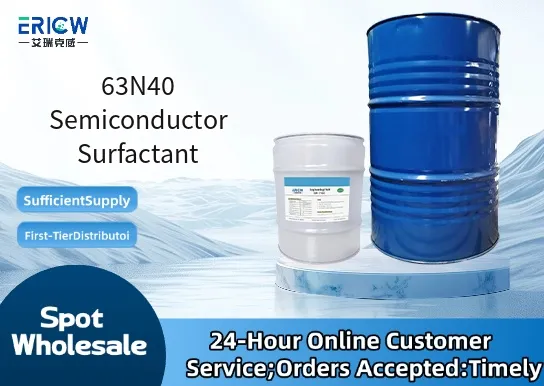
Ultra-low residue formulation designed for high-purity semiconductor wafer cleaning processes.
Non-ionic, non-foaming architecture ensures compatibility with megasonic and spray rinse equipment.
Exceptional surface tension reduction (<28 mN/m at 0.1 wt% in DI water, 25°C) enabling uniform wetting of hydrophobic photoresist and low-k dielectric surfaces.
Thermally stable up to 120°C, supporting post-etch and post-CMP cleaning at elevated temperatures.
Zero halogen and sulfur-free composition compliant with JEDEC J-STD-020 and SEMI S2 safety guidelines.
Residue removal after plasma etch (e.g., SiO₂, SiNₓ, and hard mask patterning).
Post-chemical mechanical polishing (CMP) cleaning for copper and tungsten interconnects.
Photoresist stripping aid in aqueous-based solvent systems.
Surface conditioning prior to atomic layer deposition (ALD) or CVD nucleation steps.
Particle lift-off enhancement in front-end-of-line (FEOL) and back-end-of-line (BEOL) wet cleans.
| Chemical Type | Non-ionic ethoxylated alkylphenol derivative (substituted branched-chain) |
| Product Form | Ambient-stable, clear to pale yellow liquid |
| Appearance | Clear, homogeneous liquid, free of visible particulates or phase separation |
| Primary Applications | Wafer-level cleaning, residue management, and interface activation in advanced node fabrication (≤7 nm) |
| Key Features | Low volatility, non-volatile residue (NVR) < 5 ppm, no silicone or amine contaminants |
| Benefits | Reduces micro-scratching, improves defect density (k1) control, enables sub-10 nm pattern integrity |
| Regulatory Compliance | REACH SVHC-free, RoHS 2015/863 compliant, no Prop 65 listed substances |
| Storage Stability | ≥24 months unopened at 5–30°C; no refrigeration required |
| Common Compatible Systems | Suitability |
| Deionized Water (DIW) rinse systems | Highly Recommended – Fully miscible; no cloud point below 60°C |
| Aqueous alkaline cleaners (pH 9–11) | Recommended – Stable without precipitation or hydrolysis over 72-hr contact |
| Organic co-solvent blends (e.g., PGMEA/water) | Suitable – Maintains surfactant efficacy at ≤15 vol% organic content |
| Dilute citric acid solutions (0.5–2 wt%) | Recommended – No degradation observed; effective for metal ion chelation synergy |
Q1: What is the CAS Registry Number for 63N40 Semiconductor Surfactant?
A: The CAS Number is 2274852-93-7. This unique identifier applies to the proprietary molecular structure and batch-certified purity grade used in semiconductor manufacturing.
Q2: What is the recommended working concentration range in DI water for standard wafer cleaning?
A: Typical use concentration is 0.05–0.3 wt% (500–3000 ppm), optimized per tool configuration and process step; validated via SPC-controlled dosing in cluster tools and single-wafer platforms.
Q3: How does 63N40 compare to conventional alcohol ethoxylates in terms of residue risk?
A: Unlike linear alcohol ethoxylates, 63N40 features a sterically hindered, ultra-low-VOC backbone with minimal ethoxylation by-products — resulting in >99.95% volatile residue removal during spin-rinse-dry (SRD), confirmed by FTIR and TOF-SIMS analysis.
Q4: Is 63N40 certified for use in ISO Class 1 cleanrooms and qualified under SEMI C12 standards?
A: Yes — all commercial lots undergo full SEMI C12 particle testing (≥100 L filtered), metals assay (ICP-MS, detection limit ≤0.1 ppt for Al, Cu, Fe, Ni), and outgassing screening per ASTM E595.
Q5: Has migration or leaching into low-k dielectrics (e.g., SiCOH) been evaluated?
A: Independent evaluation per SEMI F29-0712 shows no measurable penetration or chemical interaction after 60-min soak at 45°C; ellipsometry and XPS confirm intact k-value stability (Δk < 0.02).
Contact With Us:
E-mail: wangxingqiang@ericwchem.com
Have a Questions? Call Us:
Add:
Building A1, Jiete Industrial Park, Huangpu District, Guangzhou City, Guangdong Province, China