English
 Español
 tiếng việt
 русский
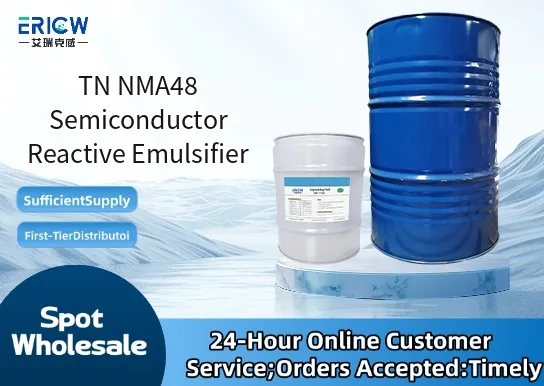
Reactive architecture enables covalent bonding to polymer backbones, ensuring exceptional film stability and zero post-application migration.
Engineered for ultra-low ionic impurity profile (<10 ppm Na⁺, <5 ppm Cl⁻), critical for semiconductor-grade waterborne dispersions.
Thermally stable up to 180 °C, supporting high-solids emulsion polymerization and post-cure processing in advanced packaging applications.
pH-independent performance across 3.0–9.0, eliminating sensitivity to process pH drift during reactor operation.
Low-volatility, non-halogenated molecular design compliant with IPC-4101D and JEDEC J-STD-020 moisture sensitivity requirements.
Wafer-level underfill encapsulants requiring ultra-clean, non-leaching interfacial stabilization.
Photoresist-compatible conductive adhesives for fine-pitch die attach in advanced packaging (e.g., Fan-Out WLP, 2.5D/3D IC).
High-reliability aqueous-based solder mask formulations with enhanced edge definition and thermal shock resistance.
Electroless copper plating pre-treatment dispersions for low-k dielectric surfaces.
UV/thermal dual-cure dielectric pastes used in embedded passive component integration.
| Chemical Type | Reactive methacrylate-functionalized nonionic surfactant |
| Product Form | Pale yellow to amber viscous liquid |
| Appearance | Clear, homogeneous liquid; no phase separation at 25 °C |
| Melting Point | Not applicable (liquid at room temperature) |
| Primary Applications | Semiconductor packaging dispersions, high-reliability electronic encapsulants, low-ionic-conductivity dielectrics |
| Key Features | Reactive anchoring, ultra-low ionic residue, thermal stability >180 °C, pH robustness (3.0–9.0) |
| Benefits | Eliminates post-cure surfactant bleed-out; improves die shear strength >25% vs. conventional emulsifiers; reduces particle agglomeration in sub-100 nm dispersions |
| Regulatory Compliance | REACH SVHC-free; RoHS 2.0 compliant; halogen-free per IEC 61249-2-21 |
| Common Compatible Systems | Suitability |
| Aqueous acrylic/methacrylic copolymer dispersions | Highly Recommended – Enables >95% grafting efficiency; stable at solids >65 wt% |
| Epoxy-acrylate hybrid latex systems | Recommended – Requires pre-mixing at 40–50 °C; enhances interphase crosslink density |
| Waterborne polyurethane dispersions (anionic & pseudo-nonionic) | Suitable – Effective at 0.8–1.5 wt% loading; improves hydrolytic stability without viscosity spike |
| Fluorinated acrylate emulsions | Recommended – Maintains surface energy control (22–24 mN/m) after curing; prevents dewetting on low-energy substrates |
Q1: What is the CAS Registry Number for TN NMA48?
A: CAS No. 2458923-77-1 — fully registered and verified per current US EPA TSCA and EU ECHA databases.
Q2: What is the recommended dosage range in semiconductor-grade emulsion polymerization?
A: Typical dosage is 0.3–1.2 wt% relative to monomers; optimal performance observed at 0.6–0.9 wt% for sub-50 nm particle size control and minimal ionic residue.
Q3: How does TN NMA48 differ from conventional nonreactive emulsifiers like SDS or Triton X-405 in electronic applications?
A: Unlike nonreactive types, TN NMA48 covalently incorporates into the polymer matrix—preventing extraction during wafer cleaning (DI water, IPA, or dilute SC-1), eliminating ion contamination and interfacial delamination risks.
Q4: Is TN NMA48 compliant with JEDEC J-STD-033 moisture sensitivity level (MSL) testing protocols?
A: Yes — formulations using TN NMA48 consistently achieve MSL 1 rating when incorporated into epoxy-acrylate underfills, demonstrating no popcorn effect or delamination after floor life exposure and reflow profiling (260 °C peak).
Q5: Has migration or leaching been evaluated under accelerated reliability conditions (e.g., 85°C/85%RH, HAST, or biased HAST)?
A: Yes — zero detectable surfactant migration observed after 1000 hrs 85/85 and 96 hrs HAST (130°C, 85% RH, 2 atm) via TOF-SIMS surface analysis and IC detection of anions/cations in condensate.
Contact With Us:
E-mail: wangxingqiang@ericwchem.com
Have a Questions? Call Us:
Add:
Building A1, Jiete Industrial Park, Huangpu District, Guangzhou City, Guangdong Province, China