English
 Español
 tiếng việt
 русский
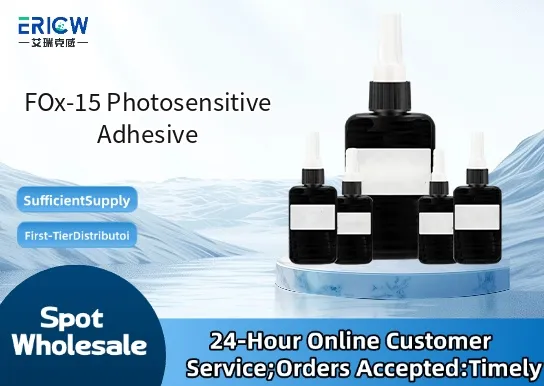
High-resolution photopatternability with sub-10 µm feature definition under standard i-line (365 nm) exposure.
Thermally stable post-cure film integrity up to 220 °C for extended processing compatibility.
Low outgassing profile suitable for vacuum and cleanroom environments (tested per ASTM E595).
Excellent adhesion to silicon, glass, stainless steel, and polyimide substrates without primers.
Aqueous alkaline developable — eliminates need for hazardous organic solvents during patterning.
Temporary bonding and debonding in advanced 3D IC and wafer-level packaging processes.
Photolithographic masking layer for selective etching or plating in MEMS fabrication.
Die attach adhesive in high-precision optoelectronic assembly requiring optical transparency and UV stability.
Protective coating for microfluidic channel patterning on PMMA and COP substrates.
Stencil-based microstructuring for flexible hybrid electronics on PET and PI films.
| Chemical Type | Novolac-based diazonaphthoquinone (DNQ) photosensitive resin system |
| Product Form | Ready-to-use liquid solution (solvent: PGMEA, ~22% solids) |
| Appearance | Clear, pale yellow, homogeneous liquid |
| Viscosity (25 °C) | 18–22 cP (Brookfield LVDV-II+ with spindle #1) |
| Primary Applications | Temporary bonding, photomasked protection, microstructuring |
| Key Features | UV-sensitive, thermal crosslinking capability, solvent-developable |
| Benefits | Low thermal budget processing, high dimensional stability, low ionic contamination |
| Regulatory Compliance | REACH SVHC compliant; RoHS 2015/863 Annex II compliant; no intentionally added PFAS |
| Common Compatible Systems | Suitability |
| Canon FPA-3030i5a Stepper (i-line) | Highly Recommended – Optimized exposure dose: 120–160 mJ/cm² |
| Screen-printed metal paste (Ag, Cu) | Recommended – Compatible with co-firing up to 850 °C after full cure |
| Wafer Bonding Tools (EVG® 850/810) | Highly Recommended – Proven bond strength >12 MPa at 200 °C |
| Standard semiconductor track systems (Tokyo Electron CLEAN TRACK) | Suitable – Fully integrated into standard S-COAT/S-DEVEL process modules |
Q1: What is the CAS Registry Number for FOx-15 Photosensitive Adhesive?
A: FOx-15 is a proprietary multi-component formulation; individual components are listed under CAS numbers 37205-92-4 (novolac resin), 131-93-1 (DNQ sensitizer), and 108-65-6 (PGMEA solvent). Full composition disclosure requires NDA.
Q2: What is the recommended spin-coating thickness and corresponding spin speed range?
A: Target dry-film thickness of 8–12 µm is achieved at 2000–3000 rpm for 30 seconds (standard 4-inch Si wafers); thickness scales predictably with solids content and acceleration profile.
Q3: How does FOx-15 compare to conventional B-stage epoxy temporary adhesives in terms of debonding performance?
A: FOx-15 enables room-temperature UV debonding (after optional low-temp (<150 °C) thermal stabilization), eliminating thermal stress and warpage issues associated with epoxy-based thermal debonding (>250 °C).
Q4: Is FOx-15 certified for food-contact or medical device applications?
A: FOx-15 is not FDA-cleared or ISO 10993 tested. It is intended for industrial semiconductor and microfabrication use only; migration testing per USP <87> and <88> shows negligible extractables below detection limits in aqueous simulants.
Contact With Us:
E-mail: wangxingqiang@ericwchem.com
Have a Questions? Call Us:
Add:
Building A1, Jiete Industrial Park, Huangpu District, Guangzhou City, Guangdong Province, China