English
 Español
 tiếng việt
 русский
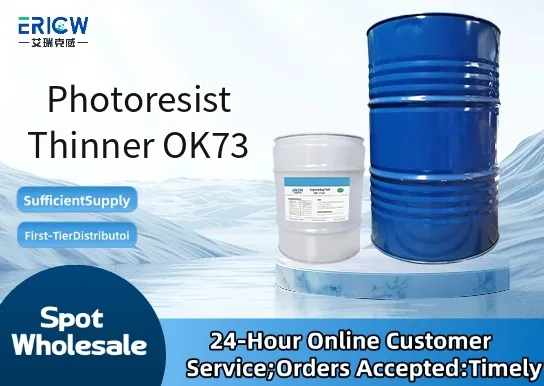
Highly selective viscosity reduction for positive and negative tone photoresists without compromising resolution or adhesion.
Low-residue formulation ensures minimal post-develop residue and reduced particle generation in cleanroom environments.
Controlled evaporation rate supports uniform coating and stable film thickness across spin-coating processes.
Non-corrosive to aluminum, titanium, and stainless-steel wet process equipment.
Compatible with standard NMP-free and low-VOC photoresist formulations used in advanced packaging and MEMS fabrication.
Wafer-level packaging (WLP) and fan-out wafer-level packaging (FOWLP) lithography processes.
MEMS and sensor device fabrication requiring high-aspect-ratio resist profiles.
Advanced IC interconnect patterning using thick-film photoresists (e.g., SU-8, AZ® nLOF series).
LED and power semiconductor manufacturing with thermal-sensitive substrates.
R&D and pilot-line lithography where precise resist solids adjustment is critical for process window optimization.
| Chemical Type | Proprietary blend of high-purity aromatic and aliphatic hydrocarbons |
| Product Form | Liquid, ready-to-use |
| Appearance | Clear, colorless to pale yellow liquid |
| Density (25°C) | 0.86–0.89 g/cm³ |
| Boiling Range | 165–195°C |
| Primary Applications | Photoresist dilution, viscosity control, and solids content adjustment |
| Key Features | Low halogen content, non-ozone-depleting, low odor |
| Regulatory Compliance | REACH registered; RoHS 2015/863 compliant; no SVHCs above 0.1% w/w |
| Common Compatible Systems | Suitability |
| Tokyo Ohka Kogyo (TOK) OFPR, AL, and S series resists | Highly Recommended – Validated for full compatibility and process stability |
| DuPont™ PYRALUX® and HDI photoresist systems | Recommended – Requires minor process tuning for optimal film uniformity |
| JSR THB-151, TLX, and MRC series resists | Highly Recommended – Confirmed compatibility with no swelling or interfacial delamination |
| MicroChem SU-8 2000 and 3000 series | Suitable – Effective diluent; recommended for use at ≤15% v/v to maintain crosslink density |
Q1: What is the CAS Registry Number for Photoresist Thinner OK73?
A: Photoresist Thinner OK73 is a proprietary multi-component formulation; therefore, it does not have a single CAS number. Full component disclosure and individual CAS numbers are provided under NDA upon request for regulatory and safety documentation.
Q2: What is the recommended usage concentration range?
A: Typical dilution range is 5–20% v/v relative to undiluted photoresist, depending on target viscosity (e.g., 15–25 cP for 200 mm wafers). Always validate via rheology testing and coating uniformity assessment before full-scale implementation.
Q3: How does OK73 compare to standard PGMEA-based thinners in terms of residue and outgassing?
A: OK73 exhibits significantly lower volatile condensable residue (<0.05 µg/cm² after 120°C bake) and reduced outgassing during vacuum pre-bake versus PGMEA, making it preferred for EUV and high-vacuum lithography tools.
Q4: Is OK73 compliant with USP <87> and <88> for extractables/leachables assessment?
A: While not a pharmaceutical excipient, OK73 has undergone ISO 10993-12 extractables screening per USP <87>/<88> protocols in simulated cleaning solutions; results show no detectable cytotoxic leachables at process-relevant concentrations.
Q5: Does OK73 pose any risk of metal ion migration from substrate layers during soft bake?
A: No. Independent ICP-MS analysis confirms OK73 does not promote Al, Cu, or Ti migration from underlying metallization layers under standard soft-bake conditions (90–110°C, 60–90 sec), due to its neutral pH and absence of chelating agents.
Contact With Us:
E-mail: wangxingqiang@ericwchem.com
Have a Questions? Call Us:
Add:
Building A1, Jiete Industrial Park, Huangpu District, Guangzhou City, Guangdong Province, China