English
 Español
 tiếng việt
 русский
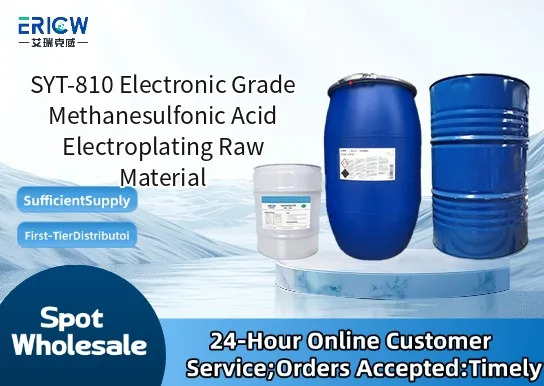
Ultra-low metallic impurities (≤10 ppt for Na, K, Ca, Fe, Ni, Cu, Zn, Cr, and Pb) meeting stringent semiconductor electroplating requirements.
Exceptional chemical stability and thermal resistance during high-current-density tin, tin-lead, and copper electroplating processes.
Non-oxidizing, non-volatile acid with negligible vapor pressure—enhances operator safety and reduces exhaust system load.
High purity (>99.99% assay) and low halide content (<50 ppt Cl⁻, Br⁻), minimizing pitting and dendrite formation on fine-pitch PCB traces.
Consistent batch-to-batch reproducibility certified via IC-MS, ICP-MS, and Karl Fischer titration per ISO/IEC 17025-accredited testing.
Acidic tin and tin-alloy plating for lead-free solderable finishes on advanced HDI and IC substrates.
Copper electroplating in through-hole and microvia filling for high-reliability automotive electronics.
Electrolyte component in wafer-level packaging (WLP) and fan-out panel-level packaging (FOPLP) plating baths.
Stripping and surface activation pretreatment for ultra-clean copper interconnects prior to barrier layer deposition.
Conductive additive formulation in next-generation electrolytic copper seed layer enhancement for 3D NAND and DRAM applications.
| Chemical Type | Methanesulfonic Acid (CH₃SO₃H), electronic grade |
| Product Form | Liquid, clear, colorless solution (typically supplied as 70 wt% aqueous) |
| Appearance | Clear, transparent, odorless liquid without suspended particles or haze |
| Melting Point | 16–17 °C (solidifies below room temperature; stored at ≥20 °C) |
| Primary Applications | Electroplating electrolyte for Sn, Sn-Pb, Cu, and specialty alloy deposition |
| Key Features | Low volatility, non-oxidizing, high conductivity, excellent metal salt solubility |
| Benefits | Enables uniform deposit distribution, reduced anode corrosion, extended bath life, lower drag-out loss |
| Regulatory Compliance | REACH SVHC-free, RoHS 3 compliant, no listed TSCA or PFAS substances |
| Common Compatible Systems | Suitability |
| Atotech EcoVia™ Sn Plating System | Highly Recommended – Fully validated for bath replenishment and maintenance |
| MacDermid Enthone TinBright® MSA Process | Highly Recommended – Compatible with all proprietary brighteners and stabilizers |
| Technic Inc. CopperStrike™ MSA-based Strike Baths | Recommended – Requires minor bath conditioning; supports >10⁶ A·h/L throughput |
| Uyemura Uniposit® Sn-Cu Alloy Plating Line | Suitable – Validated for ≤5% Sn-Cu co-deposition with optimized agitation control |
Q1: What is the CAS Registry Number for SYT-810?
A: The CAS number for methanesulfonic acid is 75-75-2; SYT-810 is a proprietary electronic-grade formulation of this compound, with full traceability and lot-specific CoA issued per shipment.
Q2: What is the recommended working concentration range in tin electroplating baths?
A: Typical operating concentration is 80–120 g/L (as 70% w/w SYT-810), corresponding to 1.2–1.8 M MSA; optimal range depends on bath temperature, current density, and additive package—validation testing is advised for new installations.
Q3: How does SYT-810 compare to sulfuric or hydrochloric acid in copper electroplating?
A: Unlike H₂SO₄ or HCl, SYT-810 offers superior metal ion solubility, negligible chloride-induced pitting, no hydrogen embrittlement risk, and compatibility with organic additives—enabling finer line resolution and improved ductility in ultra-thin deposits.
Q4: Is SYT-810 subject to migration or leaching concerns in final packaged devices?
A: No measurable migration occurs under JEDEC J-STD-020 reflow conditions (260 °C peak) due to its non-volatile nature and strong ionic binding in plated matrices; extraction studies per IPC-TM-650 2.3.25 confirm <0.05 ppm residual in post-reflow rinse water.
Contact With Us:
E-mail: wangxingqiang@ericwchem.com
Have a Questions? Call Us:
Add:
Building A1, Jiete Industrial Park, Huangpu District, Guangzhou City, Guangdong Province, China