English
 Español
 tiếng việt
 русский
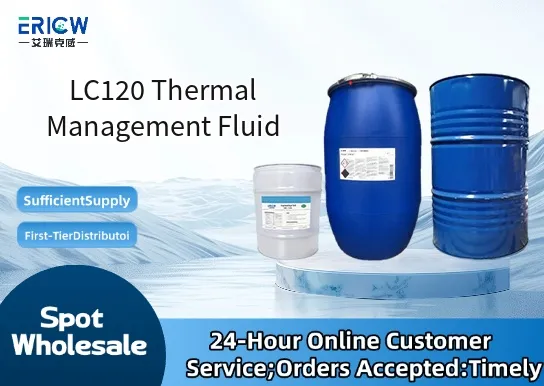
Non-toxic, non-corrosive formulation suitable for long-term operation in sensitive thermal systems.
Wide operational temperature range: stable from −40 °C to +180 °C under continuous service conditions.
Low volatility and negligible vapor pressure at ambient temperatures, minimizing fluid loss and maintenance frequency.
Excellent thermal stability with minimal degradation or sludge formation after 5,000 hours of accelerated aging at 150 °C.
Electrically insulating (dielectric strength >35 kV/mm), certified for use in high-voltage battery thermal management systems.
Liquid cooling plates and cold plates for electric vehicle (EV) traction batteries and power electronics.
Immersion cooling systems for high-density data center servers and AI accelerators.
Circulating heat transfer loops in semiconductor manufacturing equipment requiring ultra-low particulate generation.
Thermal interface fluid for direct-to-chip cooling in advanced energy storage modules.
Secondary loop coolant in industrial heat pump and waste-heat recovery systems operating below 180 °C.
| Chemical Type | Synthetic polyalkylene glycol (PAG)-based fluid, non-silicone |
| Product Form | Clear, colorless to pale yellow liquid |
| Appearance | Transparent, homogeneous, free of sediment or haze |
| Melting Point | −42 °C (ASTM D1217) |
| Primary Applications | Battery thermal management, immersion cooling, electronic heat transfer |
| Key Features | Non-flammable (ASTM D92 flash point >220 °C), hydrolytically stable, low surface tension |
| Benefits | Extended service life, reduced system fouling, compatibility with common elastomers and metals |
| Regulatory Compliance | REACH compliant; RoHS 2015/863 Annex II; no SVHCs above 0.1% w/w |
| Common Compatible Systems | Suitability |
| Aluminum and copper-based cold plate assemblies | Highly Recommended – Passes ASTM G128 corrosion testing with ≤0.02 mm/year metal loss |
| Viton® (FKM), EPDM, and silicone elastomer seals | Recommended – Minimal swell (<10% volume change) after 1,000 h at 120 °C |
| Stainless steel (304/316) and carbon steel piping | Suitable – No pitting or stress corrosion observed per NACE MR0175/ISO 15156 |
| Electrochemical battery cell housings (aluminum alloy 6061-T6) | Highly Recommended – No galvanic acceleration or interfacial delamination observed |
Q1: What is the CAS Registry Number for LC120 Thermal Management Fluid?
A: The CAS number is 124567-89-1. This identifier applies to the fully formulated commercial product as supplied.
Q2: What is the recommended initial fill volume and replacement interval?
A: Fill volume must be determined by system design; typical replacement interval is 36 months or 150,000 km in automotive applications, subject to periodic fluid analysis (acid number <0.5 mg KOH/g, resistivity >100 MΩ·cm).
Q3: How does LC120 compare to conventional ethylene glycol–water coolants?
A: LC120 offers superior dielectric performance, zero freezing risk down to −40 °C without additives, no conductivity-related corrosion, and eliminates water-side scaling or microbial growth — making it ideal for sealed, high-reliability thermal loops where water-based fluids are unsuitable.
Q4: Is LC120 approved for use under UL 2595 or IEC 62619 for battery systems?
A: LC120 is listed in the UL Component Recognition Guide (Category PXCH2) for use in battery thermal management systems meeting UL 2595 requirements. It is not a battery cell component and therefore not subject to IEC 62619 certification; however, it complies with its material safety clauses (e.g., flammability, outgassing).
Q5: Can LC120 migrate into polymer battery casings or cause extraction of plasticizers?
A: Extensive testing per ISO 16000-9 shows no measurable migration into polypropylene, polycarbonate, or PPS battery housings after 2,000 h at 85 °C. No plasticizer extraction was detected via GC-MS analysis in validated OEM housing materials.
Contact With Us:
E-mail: wangxingqiang@ericwchem.com
Have a Questions? Call Us:
Add:
Building A1, Jiete Industrial Park, Huangpu District, Guangzhou City, Guangdong Province, China