English
 Español
 tiếng việt
 русский
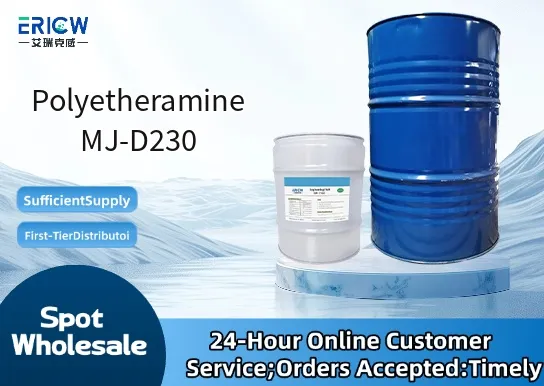
Low-viscosity, liquid aliphatic polyetheramine with primary amine functionality for rapid reactivity and efficient curing.
Excellent flexibility and impact resistance imparted to cured epoxy systems without sacrificing thermal stability.
Low color and high purity—ideal for applications requiring optical clarity or minimal yellowing over time.
Hydrophilic nature enables good compatibility with water-based epoxy dispersions and hybrid coating formulations.
Consistent molecular weight distribution (Mn ≈ 230 g/mol) ensures reproducible processing and performance across batches.
Flexible epoxy elastomers and soft-touch coatings for automotive interiors and consumer electronics.
High-performance adhesives and sealants requiring low-temperature cure capability and peel strength.
Waterborne epoxy curing agents for eco-friendly industrial maintenance and protective coatings.
Composite matrix resins in fiber-reinforced plastics (FRP) where toughness and interlaminar shear strength are critical.
Chemical-resistant linings for tanks, pipes, and secondary containment systems.
| Chemical Type | Aliphatic polyetheramine (primary amine) |
| Product Form | Clear, low-viscosity liquid |
| Appearance | Colorless to pale yellow, transparent |
| Melting Point | Below 0 °C (liquid at room temperature) |
| Amine Value | 480–520 mg KOH/g |
| Viscosity (25 °C) | 80–120 mPa·s |
| Primary Applications | Epoxy curing agent, flexible modifier, chain extender |
| Regulatory Compliance | REACH registered; no SVHCs above threshold; compliant with EU RoHS Directive |
| Common Compatible Systems | Suitability |
| Bisphenol-A epoxy resins (e.g., DGEBA) | Highly Recommended – Fast, complete cure at ambient to 60 °C with excellent flexibility |
| Waterborne epoxy dispersions | Recommended – Requires mild agitation; stable emulsion formation with low haze |
| Polyamide epoxy blends | Suitable – Enhances flexibility and reduces brittleness without compromising pot life |
| Acrylic-epoxy hybrid systems | Recommended – Improves crosslink density and substrate adhesion in UV/thermal dual-cure coatings |
Q1: What is the CAS Registry Number for Polyetheramine MJ-D230?
A: The CAS Number is 102127-24-6.
Q2: What is the typical recommended dosage when used as an epoxy curing agent?
A: Stoichiometric ratio is typically 1.0–1.1 equivalents of amine hydrogens per epoxy equivalent (EEW); actual dosage depends on resin EEW and desired Tg/flexibility—start with 12–18 phr for standard DGEBA resins.
Q3: How does MJ-D230 compare to D-230 (diethylenetriamine-based) in terms of performance and safety?
A: MJ-D230 offers lower volatility, reduced skin sensitization risk, and superior hydrolytic stability versus aromatic or linear aliphatic amines like D-230; it provides comparable reactivity but with enhanced flexibility and lower exotherm.
Q4: Is MJ-D230 suitable for food-contact or potable water applications?
A: Not approved for direct food contact under FDA 21 CFR §175.300 or NSF/ANSI 61 without formulation-specific validation; it may be used in non-leaching structural layers of certified systems when fully cured and tested per end-use requirements.
Q5: Does MJ-D230 exhibit migration or extractables in cured epoxy films exposed to solvents or humidity?
A: When fully cured, MJ-D230 forms stable covalent bonds with epoxy; residual monomer content is <0.1%, minimizing extractables—validated per ISO 10993-12 for low cytotoxicity in medical device coatings.
Contact With Us:
E-mail: wangxingqiang@ericwchem.com
Have a Questions? Call Us:
Add:
Building A1, Jiete Industrial Park, Huangpu District, Guangzhou City, Guangdong Province, China