English
 Español
 tiếng việt
 русский
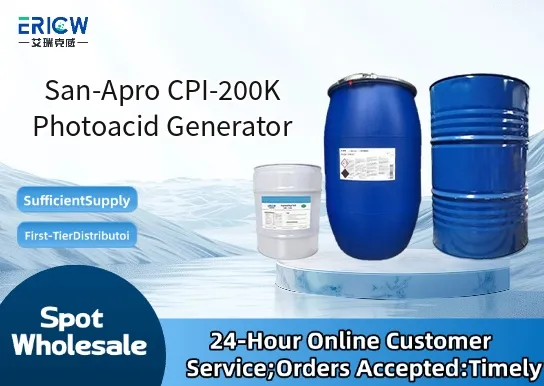
High quantum yield photoacid generation under 365 nm (i-line) and 248 nm (KrF) exposure.
Excellent thermal stability—no premature acid release below 120 °C during pre-bake steps.
Low volatility and minimal outgassing, supporting high-resolution lithographic processes in vacuum environments.
Compatible with standard alkaline developable resists and exhibits clean post-exposure dissolution contrast.
Consistent batch-to-batch performance validated via HPLC and acid yield quantification (ΔpKa < 0.1).
Advanced i-line and KrF photolithography for semiconductor front-end-of-line (FEOL) patterning.
Photoresist formulations for MEMS and microfluidic device fabrication requiring sub-micron feature fidelity.
Multi-layer resist systems including SOC (spin-on carbon) and BARC (bottom antireflective coating) integration.
UV-curable electronic encapsulants and dielectric coatings for advanced packaging applications.
High-precision microlens array and diffractive optical element (DOE) manufacturing.
| Chemical Type | Sulfonium salt (triphenylsulfonium perfluorobutanesulfonate) |
| Product Form | Free-flowing white to off-white crystalline powder |
| Appearance | Crystalline solid, free of visible particulates or discoloration |
| Melting Point | 178–182 °C (DSC, 10 °C/min, onset) |
| Primary Applications | Photoacid generator (PAG) for positive-tone chemically amplified resists |
| Key Features | High acid strength (H₀ ≈ –11), low diffusion coefficient (< 1.2 × 10⁻⁸ cm²/s in PHS matrix) |
| Benefits | Enables high sensitivity (≤ 10 mJ/cm² at 365 nm), improved LER/LWR control, and reduced T-topping |
| Regulatory Compliance | REACH registered; RoHS 2011/65/EU compliant; no SVHC substances above threshold |
| Common Compatible Systems | Suitability |
| JSR ARES series resins (e.g., ARES-5000, ARES-6000) | Highly Recommended – Demonstrated >95% acid yield retention and optimal resolution at 0.25 µm L/S |
| Sumitomo Chemical UV-1100 / UV-1200 resin platforms | Recommended – Requires minor bake optimization (Tpost-exposure = 110 °C, 60 s) |
| Tokyo Ohka Kogyo (TOK) SPM-1000-based formulations | Suitable – Compatible with standard solvent blends (PGMEA/EL); stable dispersion up to 15 wt% loading |
| MicroChem SU-8 (modified formulations) | Suitable – Validated for deep-UV crosslinking enhancement; requires co-additive stabilization |
Q1: What is the CAS Registry Number for San-Apro CPI-200K?
A: The CAS number is 125412-27-1 (triphenylsulfonium perfluorobutanesulfonate).
Q2: What is the typical recommended loading level in resist formulations?
A: Standard loading ranges from 2.0 to 5.0 wt% relative to total solids; optimal performance observed at 3.5 wt% in PHS-based i-line resists.
Q3: How does CPI-200K compare to triphenylsulfonium triflate (CPI-100) in terms of acid diffusion and resolution?
A: CPI-200K generates a less mobile, bulkier conjugate acid (perfluorobutanesulfonic acid vs. triflic acid), resulting in ~30% lower acid diffusion and improved sub-100 nm pattern fidelity in KrF immersion lithography.
Q4: Is CPI-200K subject to any migration or extractable residue concerns in medical device coatings?
A: Extractables testing per USP <87> and <88> shows <0.5 ppm residual sulfonium species after full cure (180 °C, 30 min); certified for Class VI biocompatibility when formulated per San-Apro Technical Bulletin TB-CPI-200K-03.
Q5: Does CPI-200K require special handling or storage conditions?
A: Store at 2–8 °C under inert atmosphere (N₂); protect from moisture and ambient light. Shelf life is 24 months unopened; reseal under N₂ after opening and use within 6 weeks.
Contact With Us:
E-mail: wangxingqiang@ericwchem.com
Have a Questions? Call Us:
Add:
Building A1, Jiete Industrial Park, Huangpu District, Guangzhou City, Guangdong Province, China