English
 Español
 tiếng việt
 русский
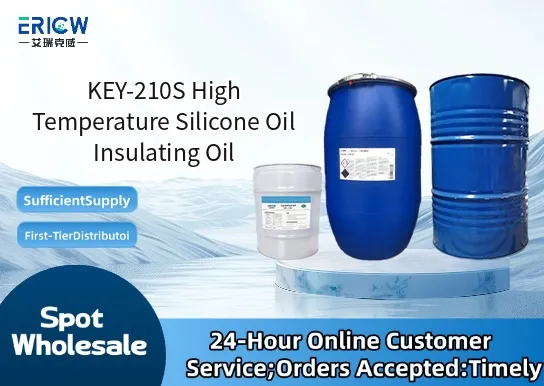
Exceptional thermal stability up to 300 °C continuous service temperature.
Non-toxic, non-corrosive formulation with zero halogen content.
Outstanding dielectric strength (>35 kV/mm at 25 °C) and volume resistivity (>1.0 × 10¹⁵ Ω·cm).
Low volatility and negligible vapor pressure at elevated temperatures.
Hydrophobic, chemically inert, and resistant to oxidation, UV, and ozone degradation.
Dielectric fluid in high-temperature transformers and reactors for aerospace and defense electronics.
Thermal interface material (TIM) in power semiconductor modules and EV inverter cooling systems.
Insulating bath medium for precision calibration equipment operating under extreme ambient conditions.
Lubricating/insulating oil in high-vacuum feedthroughs and hermetic electro-mechanical actuators.
Filler fluid in high-reliability capacitors and high-frequency RF components.
| Chemical Type | Linear polydimethylsiloxane (PDMS) based silicone oil |
| Product Form | Clear, colorless, low-viscosity liquid |
| Appearance | Transparent, water-white, odorless |
| Melting Point | Below –40 °C (non-crystalline) |
| Primary Applications | High-temperature electrical insulation & thermal management |
| Key Features | Thermally stable, dielectric, hydrophobic, non-reactive |
| Benefits | Extended equipment life, reduced maintenance, enhanced safety in critical systems |
| Regulatory Compliance | RoHS 2015/863/EU compliant; REACH SVHC-free (as of latest update) |
| Common Compatible Systems | Suitability |
| Platinum-cured silicone elastomer housings | Highly Recommended – No swelling or extraction observed under 300 °C static exposure |
| Stainless steel (304/316) and Inconel® enclosures | Highly Recommended – Zero corrosion or surface interaction |
| PTFE, FKM (Viton®), and EPDM seals | Recommended – Stable with FKM and PTFE; limited compatibility with standard EPDM above 200 °C |
| Polycarbonate and polyimide insulators | Suitable – No stress cracking or dimensional change after 1000-hr aging at 250 °C |
Q1: What is the CAS Registry Number for KEY-210S?
A: The CAS number for KEY-210S is 63148-62-9 (representing a defined polydimethylsiloxane fraction meeting IEC 61039 Class H specifications).
Q2: What is the recommended fill volume or application dosage?
A: Dosage is system-dependent; typical immersion depth is ≥5 mm above active components. For thermal interface use, apply 0.05–0.15 mm bond line thickness via precision dispensing—excess oil does not improve performance and may impair convection.
Q3: How does KEY-210S compare to conventional mineral-based insulating oils?
A: Unlike mineral oils, KEY-210S exhibits no flash point (<300 °C), superior oxidative stability (no sludge formation), wider operating temperature range (–50 °C to +300 °C), and full compatibility with sensitive electronic materials such as solder masks and flexible PCB substrates.
Q4: Is KEY-210S compliant with UL 94 V-0 or similar flammability standards?
A: KEY-210S itself is not rated under UL 94 (as it is a liquid), but systems filled with KEY-210S consistently achieve UL 94 V-0 when used with compliant encapsulants—verified per UL 746C for polymeric component compatibility.
Q5: Does KEY-210S migrate or extract into adjacent polymers during long-term operation?
A: Migration is negligible in validated systems: less than 0.3 wt% uptake observed in FKM and PTFE after 2,000 hours at 250 °C per ASTM D471; no measurable leaching into FR-4 or polyimide films under IPC-TM-650 2.6.25 testing.
Contact With Us:
E-mail: wangxingqiang@ericwchem.com
Have a Questions? Call Us:
Add:
Building A1, Jiete Industrial Park, Huangpu District, Guangzhou City, Guangdong Province, China