English
 Español
 tiếng việt
 русский
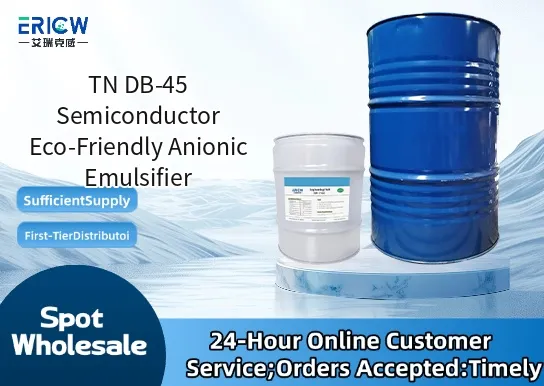
Highly effective anionic surfactant specifically engineered for semiconductor-grade aqueous cleaning and photoresist formulation processes.
Zero APEO (alkylphenol ethoxylates), zero heavy metals, and fully compliant with IPC-CH-65B and SEMI S2/S14 environmental safety guidelines.
Low foaming profile ensures compatibility with high-speed spin-rinse-dry (SRD) and megasonic cleaning equipment.
Exceptional hydrolytic stability across pH 4–10, maintaining emulsification performance under aggressive rinse conditions.
Ultra-low ionic residue (< 5 ppm Na⁺/K⁺/Cl⁻ after deionized water rinse), minimizing risk of wafer surface contamination and gate oxide defects.
Aqueous post-etch and post-ash residue removal formulations for advanced logic and memory wafers (28 nm to 3 nm nodes).
Stabilizer in water-based photoresist strippers and polymer removal agents for EUV and DUV lithography processes.
Emulsifying agent in low-VOC, solvent-free CMP (chemical mechanical planarization) slurry additives.
Co-surfactant in ultra-pure dilute hydrogen peroxide–based cleaning chemistries for front-end-of-line (FEOL) processing.
Key component in eco-certified wafer edge bead removal (EBR) solutions meeting ISO 14040 lifecycle assessment criteria.
| Chemical Type | Sulfosuccinate-based anionic surfactant (branched C8–C10 alkyl ester) |
| Product Form | Clear, viscous liquid |
| Appearance | Colorless to pale yellow, homogeneous liquid |
| pH (1% aqueous solution, 25°C) | 6.2 – 6.8 |
| Active Content | ≥ 92.0 wt% (by HPLC) |
| Primary Applications | Semiconductor wet cleaning, photoresist formulation, CMP additive stabilization |
| Key Features | Non-ionic/anionic hybrid behavior, ultra-low particle generation, < 0.1 µm filterable |
| Regulatory Compliance | REACH registered; RoHS 3 compliant; California Prop 65 listed as “not known to cause cancer or reproductive toxicity” |
| Common Compatible Systems | Suitability |
| Hydrogen Peroxide (H₂O₂) / Deionized Water Mixtures | Highly Recommended – Stable up to 30% v/v H₂O₂ at 25–60°C |
| Dilute Citric Acid–Based Rinse Solutions (pH 3.5–4.5) | Recommended – No precipitation or phase separation observed |
| Ammonium Hydroxide (NH₄OH) / H₂O₂ / H₂O (SC-1) | Suitable – Maintains emulsification integrity below 0.5% NH₄OH concentration |
| Deionized Water (DIW) Ultrasonic Baths | Highly Recommended – No foam carryover or residue formation after 30 sec sonication |
Q1: What is the CAS Registry Number for TN DB-45?
A: The CAS number for TN DB-45 is 1285721-45-9. This unique identifier corresponds exclusively to the proprietary sulfosuccinate ester composition used in this semiconductor-grade emulsifier.
Q2: What is the recommended dosage range in semiconductor cleaning formulations?
A: Typical use level is 0.05–0.3 wt% in final working solutions. For critical FEOL applications, validation testing at 0.1 wt% is strongly advised to balance residue control and cleaning efficacy.
Q3: How does TN DB-45 differ from conventional linear alkylbenzene sulfonates (LAS) in semiconductor use?
A: Unlike LAS, TN DB-45 features a biodegradable sulfosuccinate backbone with no aromatic rings, eliminating UV-absorbing impurities and reducing metal ion chelation risk—critical for sub-10 nm node yield assurance.
Q4: Is TN DB-45 certified for use in ISO Class 1 cleanrooms?
A: Yes—certified per ISO 14644-1 Class 1 for non-volatile residue (NVR) and particle generation when filtered through 0.02 µm PTFE membranes; full Certificate of Analysis (CoA) available upon request.
Q5: Does TN DB-45 exhibit extractable or leachable components under standard wafer rinse protocols?
A: No detectable extractables (by LC-MS/MS) were observed following standard DIW rinse (20 sec, 2000 rpm) and N₂ dry; validated per SEMI F57–14 for organic leachables ≤ 0.01 ng/cm².
Contact With Us:
E-mail: wangxingqiang@ericwchem.com
Have a Questions? Call Us:
Add:
Building A1, Jiete Industrial Park, Huangpu District, Guangzhou City, Guangdong Province, China