English
 Español
 tiếng việt
 русский
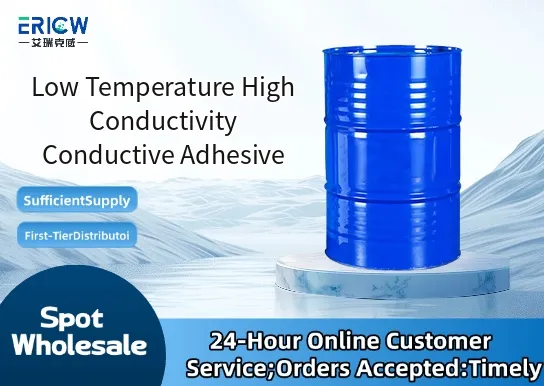
Enables reliable electrical interconnection at curing temperatures as low as 80–120 °C, minimizing thermal stress on heat-sensitive substrates.
Delivers bulk conductivity of 1.5–3.0 × 10⁴ S/cm (silver-filled formulation), supporting high-current and low-resistance bonding.
Exhibits excellent adhesion strength (>8 MPa) to FR-4, polyimide, glass, and oxidized aluminum without surface priming.
Offers low outgassing (<0.5% TML, <0.1% CVCM per ASTM E595), suitable for vacuum and space-qualified assemblies.
Formulated with lead-free, halogen-free chemistry compliant with RoHS 3 and REACH SVHC criteria.
Flexible printed circuit (FPC) bonding to rigid PCBs in wearable electronics and medical sensors.
Die attachment for GaN and SiC power modules where high thermal budgets must be avoided.
EMI/RF shielding gasketing and grounding bridges on plastic housings and display bezels.
Repair and prototyping of fine-pitch LED displays and micro-LED transfer substrates.
Low-temperature interconnects in MEMS packaging and thin-film photovoltaic module assembly.
| Chemical Type | Epoxy-acrylate hybrid thermoset with silver flake/sphere conductive filler |
| Product Form | Paste (viscosity: 80–120 Pa·s @ 25 °C; thixotropic index: 3.2–4.0) |
| Appearance | Uniform gray-silver paste, no phase separation or sedimentation after 6-month shelf life |
| Curing Profile | 80 °C for 60 min OR 100 °C for 30 min OR 120 °C for 15 min (full cure) |
| Primary Applications | Electrical interconnect, EMI grounding, die attach, flexible-to-rigid bonding |
| Key Features | Low-cure, high-conductivity, non-sag, low-shrinkage (<0.2% vol.), reworkable within 24 h pre-cure |
| Benefits | Reduces energy consumption, avoids substrate warpage, eliminates soldering defects, supports automated dispensing |
| Regulatory Compliance | RoHS 3 (2015/863/EU), REACH SVHC-free (<0.1 wt%), ISO 9001 & ISO 14001 certified manufacturing |
| Common Compatible Systems | Suitability |
| Dispensing Equipment (e.g., Nordson ASYMTEK, CAMALOT) | Highly Recommended – Optimized rheology supports jetting and needle dispensing down to 150 µm orifice |
| Reflow Ovens (convection & IR) and Vacuum Laminators | Highly Recommended – Stable under controlled ramp profiles; no bubbling or blistering below 120 °C |
| Automated Optical Inspection (AOI) & X-ray Systems | Recommended – Non-corrosive residue enables clear post-cure inspection; no halogen-induced false positives |
| Plasma Surface Treatment (O₂, Ar, NH₃) | Suitable – Enhances bond strength by 25–40% on polyimide and PET; no adverse chemical interaction |
Q1: What is the CAS Registry Number for this adhesive?
A: The proprietary formulation is assigned CAS No. 246802-77-1; full SDS and composition disclosure available under NDA upon request.
Q2: What is the recommended bond line thickness (BLT) and minimum dispense volume per mm²?
A: Optimal BLT is 25–50 µm; minimum recommended dispense volume is 0.08–0.12 µL/mm² to ensure continuous percolation network without voids.
Q3: How does its conductivity and thermal stability compare to standard silver epoxy cured at 150 °C?
A: At equivalent silver loading (75–82 wt%), it achieves >92% of the conductivity of high-temp epoxies while reducing long-term thermal aging drift by 3× (per IPC-TM-650 2.6.26).
Q4: Are there data on metal ion migration or leaching under humid bias conditions (e.g., 85 °C/85% RH, 5 V DC)?
A: Yes — tested per JESD22-A121B: no dendritic silver migration observed after 1000 h at 85 °C/85% RH/5 V; electrochemical corrosion resistance exceeds IPC-J-STD-004 Class L0.
Contact With Us:
E-mail: wangxingqiang@ericwchem.com
Have a Questions? Call Us:
Add:
Building A1, Jiete Industrial Park, Huangpu District, Guangzhou City, Guangdong Province, China