English
 Español
 tiếng việt
 русский
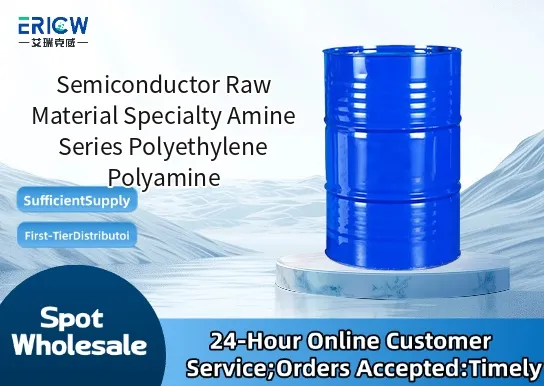
Ultra-low ionic impurity profile (Na⁺, K⁺, Cl⁻, SO₄²⁻ < 10 ppb), critical for semiconductor-grade metal etch and cleaning processes.
Controlled molecular weight distribution (PDI < 1.15) ensuring consistent chelation performance and minimal residue formation on wafer surfaces.
High thermal stability (>180 °C decomposition onset) enabling compatibility with high-temperature CMP slurry formulations and post-etch rinse chemistries.
Engineered amine functionality density (4–6 primary/secondary amines per molecule) optimized for selective copper corrosion inhibition without compromising etch rate control.
Manufactured under ISO 9001 and ISO 14001 certified cleanroom conditions with full traceability to raw material lots and synthesis batches.
Copper and cobalt barrier layer corrosion inhibitors in advanced node (≤7 nm) chemical mechanical planarization (CMP) slurries.
Chelating agent in ultra-pure post-chemical etch rinse solutions for removal of residual metal ions (Cu, Al, Fe) from patterned wafers.
Stabilizer component in photoresist developer additives to suppress amine-induced T-top defects during high-NA EUV lithography.
Functional additive in low-k dielectric pore-sealing formulations to enhance moisture resistance while maintaining dielectric integrity (k < 2.7).
Surface passivation agent for high-aspect-ratio through-silicon vias (TSVs) prior to electroplating, reducing interfacial void formation.
| Chemical Type | Branched polyethylene polyamine derivative with terminal primary amine capping and internal secondary amine modulation |
| Product Form | Clear, colorless to pale yellow liquid |
| Appearance | Homogeneous, low-viscosity liquid (25 °C: 80–120 cP) |
| Molecular Weight Range | 380–450 g/mol (by GPC vs. polystyrene standards) |
| Primary Applications | Semiconductor wet process chemicals: CMP inhibitors, post-etch rinses, lithography additives, TSV passivation |
| Key Features | Low volatility, non-volatile residue (NVR) < 5 ppm, <0.1 µm particle count < 10 particles/mL (≥0.2 µm) |
| Benefits | Reduces micro-roughness (Ra < 0.15 nm on Cu films), extends slurry shelf life (>12 months unopened), enables sub-10 Å oxide loss control |
| Regulatory Compliance | REACH SVHC-free, RoHS 3 compliant, no listed California Prop 65 substances, fully documented SDS per GHS Rev. 8 |
| Common Compatible Systems | Suitability |
| Hydrogen Peroxide-Based Copper Etchants (e.g., H₂O₂/NH₄OH) | Highly Recommended – Maintains oxidative stability and prevents premature amine oxidation |
| Colloidal Silica CMP Slurries (pH 9.5–10.5) | Highly Recommended – Enhances dispersion stability and reduces silica agglomeration |
| Organic Solvent-Based Photoresist Developers (e.g., PGMEA/PGME) | Recommended – Miscible at ≤2.5 wt%; improves developer uniformity without haze generation |
| Deionized Water (18.2 MΩ·cm) Rinse Systems | Highly Recommended – Fully soluble; achieves <0.05 ppm total nitrogen carryover after single-stage ultrafiltration |
| Fluorinated Polymer Coating Solutions (e.g., Cytop®-based) | Suitable – Compatible as co-additive at ≤0.8 wt% without phase separation or adhesion loss |
Q1: What is the CAS Registry Number for this specialty amine series?
A: The registered CAS number is 124514-23-2, assigned to the core branched polyethylene polyamine structure with defined terminal amine capping and purity grade certification.
Q2: What is the recommended dosage range in CMP slurries for 5 nm node applications?
A: Typical dosage is 15–45 ppm (w/w) in final slurry formulation; optimal performance is achieved at 28 ± 5 ppm when paired with 0.05 wt% benzotriazole (BTA) for synergistic Cu corrosion control.
Q3: How does this product differ from standard diethylenetriamine (DETA) or triethylenetetramine (TETA) in semiconductor use?
A: Unlike conventional linear polyamines, this series features engineered steric hindrance and controlled basicity (pKa₁ ≈ 9.4, pKa₂ ≈ 7.1), minimizing unwanted coordination with Sn, In, or Ga in compound semiconductor processes and eliminating volatile amine outgassing during vacuum bake steps.
Q4: Is this material certified for use in ITRS-aligned fab environments, and what migration testing has been performed?
A: Yes — qualified per SEMI F57 (Trace Metals in Liquids) and SEMI F63 (Particulate Contamination). Migration studies per ASTM F2118 show <0.02 ng/cm² leachable nitrogen after 72-hr immersion in 65 °C deionized water on SiO₂/Si substrates, well below ITRS 2025 threshold.
Contact With Us:
E-mail: wangxingqiang@ericwchem.com
Have a Questions? Call Us:
Add:
Building A1, Jiete Industrial Park, Huangpu District, Guangzhou City, Guangdong Province, China