English
 Español
 tiếng việt
 русский
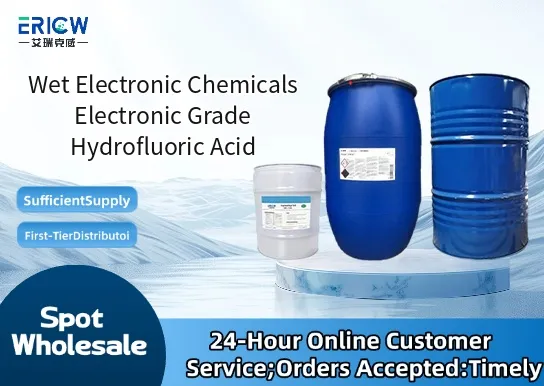
Ultra-low metallic impurities (≤10 ppt for Na, K, Fe, Cu, Ni, Cr, Zn, Al)
Controlled particulate count (<5 particles/mL ≥0.1 μm per ISO 14644-1 Class 1)
High chemical purity (>99.999% HF, trace H₂O content <100 ppm)
Stable concentration (49.0–49.5 wt% aqueous solution) with tight batch-to-batch consistency
Manufactured and packaged under ISO Class 4 cleanroom conditions in fluoropolymer-lined containers
Silicon dioxide (SiO₂) etching in front-end-of-line (FEOL) semiconductor manufacturing
Removal of native oxide layers prior to epitaxial growth or gate stack deposition
Cleaning of photomask substrates and reticles in advanced lithography processes
Post-CMP residue removal for shallow trench isolation (STI) and interlayer dielectric (ILD) patterning
Surface conditioning of MEMS and advanced packaging substrates
| Chemical Type | Aqueous hydrofluoric acid (HF) |
| Product Form | Liquid solution |
| Concentration | 49.0–49.5 wt% HF in deionized water |
| Appearance | Clear, colorless liquid |
| Primary Applications | Semiconductor wafer cleaning, SiO₂/Si₃N₄ selective etching, photomask maintenance |
| Key Features | Low cationic/ionic contamination, ultra-low particle count, high stability in fluoropolymer packaging |
| Benefits | Minimizes device defects, enables sub-7 nm node process compatibility, reduces rework rates |
| Regulatory Compliance | REACH SVHC-free, RoHS compliant, SDS available; meets SEMI C1/C37 standards |
| Common Compatible Systems | Suitability |
| SEMI-standard wet bench platforms (e.g., SCREEN, Tokyo Electron, Lam Research) | Highly Recommended – Fully validated for automated dispense, temperature control, and recirculation |
| Single-wafer spin-rinse-dry (SRD) tools | Recommended – Requires optimized flow rate and dwell time to prevent residue formation |
| Photomask cleaning systems (e.g., Dainippon Screen MSA series) | Highly Recommended – Validated for quartz/chrome mask integrity and defect performance |
| Batch immersion tanks with PFA/PVDF linings | Suitable – Requires strict monitoring of bath life and particle generation |
Q1: What is the CAS Number for electronic grade hydrofluoric acid?
A: The CAS Number is 7664-39-3.
Q2: How does usage volume compare between electronic grade and industrial grade HF?
A: Electronic grade HF is used at significantly lower volumes per wafer (typically 5–50 mL/batch), emphasizing precision delivery and minimal waste—unlike industrial grade, which is applied in bulk for metal pickling or glass etching.
Q3: Does this product contain stabilizers or chelating agents?
A: No. This formulation is free of added stabilizers, surfactants, or chelators to prevent unintended interactions with sensitive device layers or contamination of process tools.
Q4: Is there risk of fluorosilicic acid (H₂SiF₆) formation during storage or use?
A: Minimal risk under controlled conditions; H₂SiF₆ formation is suppressed by maintaining low silica exposure (via fluoropolymer packaging) and avoiding contact with glass/quartz surfaces during handling.
Q5: Are migration or extractables data available for container materials?
A: Yes—comprehensive extractables testing per SEMI F57 confirms <1 ppt leachable fluoropolymers (PFA, FEP) and no detectable metal or organic migration after 30-day contact at 25°C.
Contact With Us:
E-mail: wangxingqiang@ericwchem.com
Have a Questions? Call Us:
Add:
Building A1, Jiete Industrial Park, Huangpu District, Guangzhou City, Guangdong Province, China