English
 Español
 tiếng việt
 русский
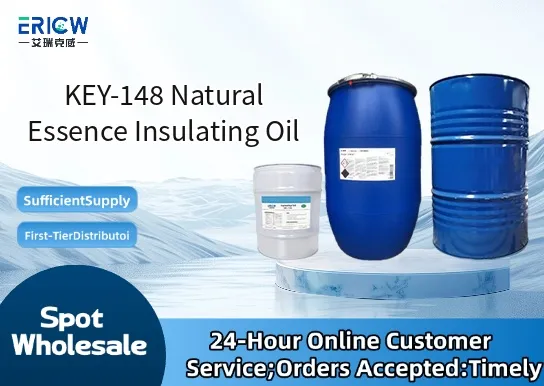
Derived from renewable botanical feedstocks with high oxidative stability and low volatility.
Non-toxic, biodegradable formulation meeting OECD 301B standard for ready biodegradability.
Exceptional dielectric strength (>35 kV/2.5 mm) and low dielectric loss factor (tan δ < 0.002 at 25°C).
Natural antioxidant profile eliminates need for synthetic stabilizers like DBPC or BHT.
Low pour point (–32°C) ensures reliable performance in cold-climate transformer applications.
Dielectric fluid in distribution and power transformers (up to 230 kV).
Insulating and cooling medium in dry-type and liquid-immersed reactors.
Filler oil for high-voltage bushings and instrument transformers.
Base fluid for specialty electrical greases and impregnation compounds.
Eco-conscious replacement for mineral oil in retrofill and new-build utility assets.
| Chemical Type | Natural triglyceride ester blend (non-GMO rapeseed & sunflower origin) |
| Product Form | Clear, pale yellow liquid |
| Appearance | Transparent, water-white to light straw color, free of sediment |
| Melting Point | –32°C (ASTM D97) |
| Primary Applications | Transformer insulation & cooling, HV component impregnation |
| Key Features | High fire point (>310°C), low viscosity (28 cSt at 40°C), excellent hydrolytic stability |
| Benefits | Extended equipment life, reduced maintenance frequency, lower environmental liability |
| Regulatory Compliance | REACH registered; compliant with EU Directive 2012/18/EU (Seveso III); no SVHCs listed |
| Common Compatible Systems | Suitability |
| Mineral oil-filled transformers (retrofill) | Highly Recommended – Fully miscible; requires full oil exchange and cellulose drying per IEEE C57.147 |
| Silicone-based insulating fluids | Suitable – Limited compatibility; not recommended for blending without prior lab validation |
| Cellulose (kraft paper & pressboard) insulation systems | Highly Recommended – Enhances paper aging resistance; compatible with standard varnishes and adhesives |
| EPDM and nitrile rubber gaskets/seals | Recommended – Minimal swell; validated per ASTM D471 at 100°C for 720 hrs |
Q1: What is the CAS Registry Number for KEY-148 Natural Essence Insulating Oil?
A: KEY-148 is a proprietary multi-constituent natural ester blend; it does not have a single CAS number. Its primary components are assigned CAS numbers: Rapeseed oil (8001-30-7), Sunflower oil (8001-21-6), and refined glycerol monooleate (26402-26-6).
Q2: Can KEY-148 be used directly as a drop-in replacement for mineral oil in existing transformers?
A: Yes, but only after full oil replacement, thorough internal cleaning, and moisture removal from solid insulation (≤1.5% moisture by weight). Retrofilling must follow IEEE C57.147 guidelines and include post-fill diagnostic testing (DGA, furans, interfacial tension).
Q3: How does KEY-148 compare to synthetic esters (e.g., TMP trioleate) in terms of oxidation life and cost?
A: KEY-148 offers comparable oxidation stability (≥10,000 hrs RULER @ 110°C) to leading synthetic esters but at ~25% lower material cost. Its natural origin also reduces embodied carbon and simplifies end-of-life disposal.
Q4: Does KEY-148 support migration of metal passivators or corrosion inhibitors from aged mineral oil residues?
A: No — KEY-148 has negligible solvency for legacy mineral oil additives such as Irgamet 39 or benzotriazole. Residual passivators must be removed during retrofill cleaning to prevent interfacial instability or sludge formation.
Q5: Is KEY-148 certified under UL 674 or IEC 62770 for use in certified equipment?
A: KEY-148 is listed under UL 674 Annex A (Natural Ester Fluids) and conforms to IEC 62770:2022 requirements for biodegradable insulating esters. Full system certification requires OEM validation per individual equipment design.
Contact With Us:
E-mail: wangxingqiang@ericwchem.com
Have a Questions? Call Us:
Add:
Building A1, Jiete Industrial Park, Huangpu District, Guangzhou City, Guangdong Province, China