English
 Español
 tiếng việt
 русский
Ultra-high purity (≥99.9999% / 6N) with stringent control of metallic impurities (<10 ppt) and particulates.
Consistent batch-to-batch reproducibility, certified via GC-TCD/FID and FTIR trace gas analysis.
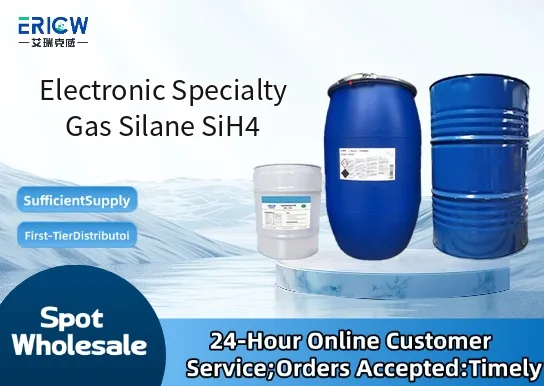
Stabilized cylinder delivery system with electropolished 316L stainless steel valves and diaphragm seals to prevent contamination.
Low moisture content (<0.1 ppmv H₂O) and oxygen impurity (<0.1 ppmv O₂) for reliable thin-film nucleation.
Compliant with SEMI C12 and ISO 8573-1 Class 1:1:1 for particle and contaminant control in microelectronics environments.
Chemical vapor deposition (CVD) of silicon-containing films including amorphous silicon (a-Si), silicon nitride (Si₃N₄), and silicon carbide (SiC).
Plasma-enhanced chemical vapor deposition (PECVD) for solar cell passivation layers and TFT backplanes.
Epitaxial growth of single-crystal silicon layers in advanced logic and memory device fabrication.
In-situ doped silicon layer formation during low-temperature semiconductor processing.
Nanowire and quantum dot synthesis in research-scale nanoelectronics and photovoltaic development.
| Chemical Type | Silicon hydride (monosilane) |
| CAS Number | 7803-62-1 |
| Product Form | Compressed gas in high-pressure seamless steel cylinder (typically 10–50 L water capacity) |
| Appearance | Colorless, non-corrosive gas at ambient conditions |
| Melting Point | −185 °C |
| Boiling Point | −112 °C |
| Primary Applications | Microelectronics CVD/PECVD, photovoltaics, MEMS, display manufacturing |
| Regulatory Compliance | REACH registered; GHS-compliant SDS; OSHA 29 CFR 1910.1200; SEMI E52-0218 |
| Common Compatible Systems | Suitability |
| Applied Materials Centura® PECVD Platform | Highly Recommended – Validated for uniform a-Si:H film deposition at ≤300 °C |
| Lam Research Kiyo® CVD System | Highly Recommended – Certified for SiNₓ barrier layer formation with <0.5% thickness variation |
| TEL CleanTrack™ LITHIUS+ Coater/Developer | Recommended – Compatible with integrated silane-based surface treatment modules |
| ASM International Eagle XP8™ | Suitable – Supports silane flow integration for low-thermal-budget epitaxy; requires custom gas panel calibration |
Q1: What is the CAS number for electronic-grade silane (SiH₄)?
A: The CAS Registry Number for silane is 7803-62-1. All electronic-grade batches are traceably certified against this identifier per IUPAC nomenclature and regulatory databases.
Q2: How does silane consumption compare to alternative silicon precursors like dichlorosilane (DCS) or trichlorosilane (TCS) in CVD processes?
A: Silane offers higher silicon utilization efficiency (≈92–96%) and lower thermal decomposition temperature (≤500 °C), reducing energy demand and minimizing chlorine-related corrosion vs. DCS/TCS. However, it requires stricter handling due to pyrophoricity.
Q3: Is electronic-grade silane compatible with standard stainless-steel gas distribution systems?
A: Yes—when using electropolished 316L SS components with metal-sealed VCR® or VCO® fittings and validated leak integrity (<1×10⁻⁹ atm·cm³/s He). Avoid brass, aluminum, or elastomer contact to prevent catalytic decomposition.
Q4: Does silane require special regulatory certification for export to the EU or Japan?
A: Yes—it is listed under EU Dual-Use Regulation (Annex I, Category 1.C.1.d) and Japan’s Foreign Exchange and Foreign Trade Act (FEFTA). Export requires end-use declaration and, where applicable, a license from national authorities (e.g., BIS in US, METI in Japan).
Contact With Us:
E-mail: wangxingqiang@ericwchem.com
Have a Questions? Call Us:
Add:
Building A1, Jiete Industrial Park, Huangpu District, Guangzhou City, Guangdong Province, China