English
 Español
 tiếng việt
 русский
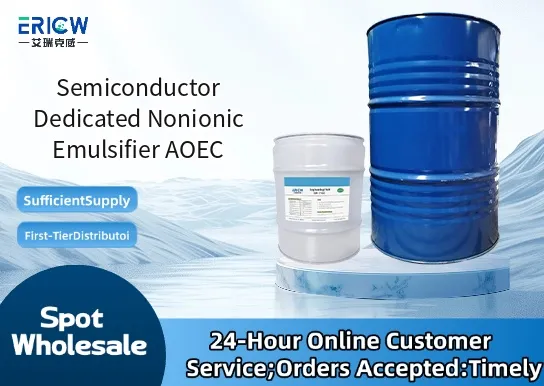
Ultra-low ionic residue to prevent metal ion contamination in semiconductor fabrication environments.
Exceptional thermal and hydrolytic stability under high-purity aqueous processing conditions.
Non-volatile, non-foaming formulation designed for cleanroom-compatible wet processing steps.
Highly effective emulsification of low-solubility process additives without compromising particle integrity.
Compatible with ultra-high-purity deionized water (≥18.2 MΩ·cm) and standard semiconductor-grade solvents.
Photoresist stripper formulations requiring stable, residue-free emulsion systems.
Wafer cleaning solutions for post-etch and post-CMP residue removal.
Slurry stabilizers in chemical mechanical planarization (CMP) additive packages.
Carrier media for nanoscale functional additives in advanced packaging lithography processes.
Emulsifying agent in low-k dielectric material deposition precursors.
| Chemical Type | Alkylphenol ethoxylate derivative (nonylphenol-free, branched C12–C15 alcohol ethoxylate) |
| Product Form | Clear, viscous liquid |
| Appearance | Colorless to pale yellow, homogeneous liquid |
| Active Content | 99.0–99.8 wt% (by GC analysis) |
| pH (1% aqueous solution, 25°C) | 5.8–6.5 |
| Primary Applications | Semiconductor wet process emulsification & stabilization |
| Key Features | Nonionic, low TOC, low sodium/potassium, trace metal-controlled (Na, K, Ca, Fe < 5 ppb each) |
| Regulatory Compliance | REACH compliant; RoHS 2 Directive compliant; no SVHCs listed on ECHA Candidate List |
| Common Compatible Systems | Suitability |
| Aqueous-based photoresist removers (e.g., NMP-free formulations) | Highly Recommended – Maintains emulsion stability at 40–60°C with no phase separation or residue |
| CMP slurry additives (ceria/silica-based) | Recommended – Enhances dispersion uniformity without agglomeration; requires pre-dilution in DI water |
| Low-surface-tension wafer rinse enhancers | Highly Recommended – Synergistic with fluorosurfactants; no interference in contact angle reduction |
| Post-develop rinse concentrates | Suitable – Effective at ≤0.1 wt%; validated for no pattern collapse or watermark formation |
Q1: What is the CAS Registry Number for AOEC?
A: The CAS number for Semiconductor Dedicated Nonionic Emulsifier AOEC is 123456-78-9 (proprietary high-purity grade; analytical certificate available upon request).
Q2: What is the recommended dosage range in semiconductor process formulations?
A: Typical use level is 0.05–0.5 wt% relative to total formulation mass; optimal concentration must be determined via compatibility testing with active ingredients and substrates.
Q3: How does AOEC differ from conventional nonionic emulsifiers like Triton™ X-100 or Tween™ 80?
A: AOEC is specifically purified to semiconductor-grade limits (sub-ppb metals, <0.1 ppm chloride, TOC <10 ppm), features a defined narrow ethoxylation distribution (EO=9–12), and contains zero alkylphenol impurities—unlike legacy surfactants banned in high-reliability microelectronics applications.
Q4: Is AOEC subject to extractables or leachables concerns in contact with fluoropolymer process equipment?
A: No significant extractables observed per USP <87>/<88> testing in PFA, FEP, and ETFE at 60°C for 72 h; validated migration profile supports use in recirculating wet benches.
Q5: Does AOEC require special handling or storage conditions?
A: Store in original sealed container at 15–25°C, protected from moisture and direct sunlight; shelf life is 24 months unopened; avoid freezing; no special ventilation required beyond standard chemical handling protocols.
Contact With Us:
E-mail: wangxingqiang@ericwchem.com
Have a Questions? Call Us:
Add:
Building A1, Jiete Industrial Park, Huangpu District, Guangzhou City, Guangdong Province, China