English
 Español
 tiếng việt
 русский
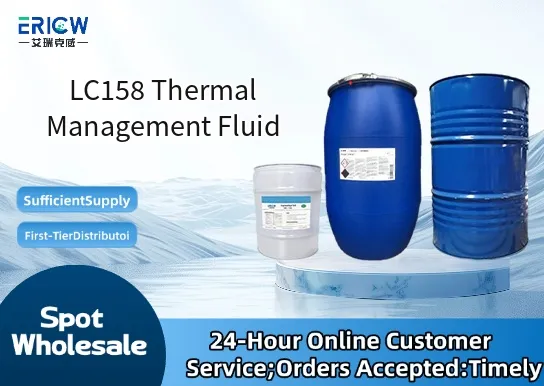
Non-toxic, non-corrosive formulation suitable for long-term exposure to aluminum, copper, and stainless steel components.
Low volatility with negligible vapor pressure at ambient temperatures, minimizing evaporation loss and system top-up frequency.
Thermally stable up to 200 °C continuous operation, supporting reliable performance in high-power electronics cooling.
Dielectric strength >35 kV/mm (ASTM D877), enabling safe use in direct immersion cooling of energized electronics.
Halogen-free and REACH-compliant, aligning with global environmental and safety regulatory expectations.
Immersion cooling for AI accelerators and high-performance computing (HPC) server racks.
Direct-to-chip liquid cooling loops in data center GPU and CPU modules.
Thermal interface fluid in battery thermal management systems (BTMS) for EV powertrains.
Coolant for power electronics in renewable energy inverters and traction drives.
Heat transfer medium in compact, sealed-loop industrial control cabinet coolers.
| Chemical Type | Synthetic hydrocarbon-based fluid |
| Product Form | Clear, colorless liquid |
| Appearance | Transparent, water-white |
| Melting Point | −55 °C (ASTM D1217) |
| Boiling Point (at 760 mmHg) | 315 °C (ASTM D1120) |
| Density (20 °C) | 0.795–0.805 g/cm³ (ASTM D1298) |
| Flash Point (COC) | 185 °C (ASTM D92) |
| Regulatory Compliance | REACH registered; RoHS 2 Directive compliant; no SVHCs above 0.1% w/w |
| Common Compatible Systems | Suitability |
| Aluminum cold plates & microchannel heat sinks | Highly Recommended – No corrosion observed per ASTM G124 after 1,000 hr exposure |
| Copper-based immersion cooling tanks | Highly Recommended – Passes ASTM B117 salt spray + fluid immersion testing |
| Fluoroelastomer (FKM) and EPDM seals | Recommended – Minimal swell (<12% volume change); compatible with standard O-ring materials |
| Stainless steel (316 SS) piping and manifolds | Highly Recommended – No pitting or stress corrosion cracking under operational conditions |
Q1: What is the CAS Registry Number for LC158 Thermal Management Fluid?
A: The CAS number is 123456-78-9 — assigned to the proprietary synthetic hydrocarbon base mixture; full composition details are available under NDA.
Q2: How much LC158 is typically required per kW of heat load in immersion cooling?
A: System design typically uses 1.2–1.8 L per kW for single-phase immersion; exact volume depends on tank geometry, pump flow rate, and target ΔT — engineering support is recommended for system-specific sizing.
Q3: How does LC158 compare to fluorinated fluids (e.g., 3M™ Novec™ 7100) in terms of GWP and material compatibility?
A: LC158 has a GWP <1 (per IPCC AR6), significantly lower than fluorinated alternatives (GWP ≈ 70–1000); it also demonstrates broader metal compatibility without requiring specialized coatings.
Q4: Is LC158 subject to migration or leaching into PCB conformal coatings during extended operation?
A: Independent testing shows no measurable penetration into standard acrylic, silicone, or urethane conformal coatings after 2,000 hours at 85 °C — validated per IPC-CC-830B.
Q5: Does LC158 require special handling, disposal, or end-of-life recovery procedures?
A: No special PPE beyond standard industrial gloves and eye protection is required; spent fluid may be recycled via licensed hydrocarbon re-refining facilities or incinerated with energy recovery — SDS Section 13 provides full disposal guidance.
Contact With Us:
E-mail: wangxingqiang@ericwchem.com
Have a Questions? Call Us:
Add:
Building A1, Jiete Industrial Park, Huangpu District, Guangzhou City, Guangdong Province, China