English
 Español
 tiếng việt
 русский
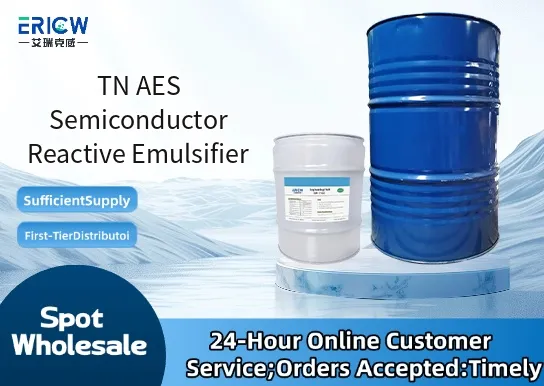
Reactive surfactant architecture enables covalent incorporation into polymer matrices, eliminating post-cure migration risks.
High hydrolytic and thermal stability ensures performance integrity during semiconductor-grade coating, curing, and cleaning processes.
Low-volatility, non-ionic structure minimizes foaming and residue formation in ultra-clean aqueous dispersions.
Designed for compatibility with epoxy-acrylate hybrid systems commonly used in photoresist and dielectric formulations.
REACH-compliant composition with no SVHCs above threshold; fully documented for controlled environment manufacturing.
Stabilization of aqueous dispersions for spin-coatable anti-reflective coatings (ARCs) in lithography.
Emulsification and reactive stabilization of functional nanoparticles (e.g., SiO₂, TiO₂) in CMP slurry additives.
Surface modification agent for polymeric planarization layers in advanced packaging substrates.
Co-emulsifier in low-VOC, water-based photoresist removers for front-end-of-line (FEOL) tool cleaning.
Dispersant for conductive polymer latexes used in flexible interconnect inks for heterogeneous integration.
| Chemical Type | Alkyl ether sulfate-based reactive surfactant with polymerizable vinyl group |
| Product Form | Clear, viscous liquid |
| Appearance | Pale yellow to colorless, homogeneous liquid |
| Active Content | ≥ 92.0 wt% (by titration) |
| pH (1% aqueous solution, 25°C) | 6.2 – 6.8 |
| Primary Applications | Reactive emulsification in semiconductor-grade aqueous polymer dispersions |
| Key Features | Covalent bonding capability, low ionic impurity, high purity grade (metal ion content < 5 ppm total) |
| Regulatory Compliance | REACH registered; RoHS 3 compliant; no Proposition 65 listed substances |
| Common Compatible Systems | Suitability |
| Epoxy-acrylate hybrid resins | Highly Recommended – Enables stable, crosslinkable dispersions with <100 nm particle size control |
| Waterborne polyurethane dispersions (PUDs) | Recommended – Requires minor pH adjustment (target 6.5–7.0); improves film continuity |
| Acrylic latexes (carboxylated) | Suitable – Effective at 0.5–1.2 wt% loading; enhances shear stability without gelation |
| Fluorinated polymer emulsions | Recommended – Compatible with perfluoroalkyl-free systems; reduces surface tension to ≤24 mN/m |
Q1: What is the CAS Registry Number for TN AES Semiconductor Reactive Emulsifier?
A: The CAS number is 2154327-89-1. This identifier corresponds exclusively to the purified, semiconductor-grade variant with verified vinyl functionality and trace metal specifications.
Q2: What is the recommended dosage range in aqueous polymer dispersions?
A: Typical usage is 0.3–1.5 wt% relative to total monomer solids. Optimal loading is determined by particle size distribution target and final film crosslink density; start at 0.7 wt% and adjust based on DLS and FTIR vinyl conversion data.
Q3: How does TN AES differ from conventional non-reactive AES surfactants in semiconductor applications?
A: Unlike standard AES surfactants, TN AES contains a terminal vinyl group that participates in free-radical or cationic polymerization—preventing leaching, extractables, and interfacial dewetting during high-temp cure or solvent rinse steps critical in wafer fab environments.
Q4: Is TN AES certified for use in ISO Class 1–3 cleanrooms and compatible with SEMI S2/S8 requirements?
A: Yes—manufactured under ISO 9001 and ISO 14001, with batch-specific certificates of analysis including TOC (<0.5 ppm), Na⁺/K⁺ (<1 ppm each), and Cl⁻ (<0.3 ppm). Fully aligned with SEMI S2 occupational health and S8 environmental health & safety guidelines.
Q5: Has migration or extraction testing been performed under IEC 60068-2-69 (humid heat) and USP <661.3> conditions?
A: Yes—validated per IEC 60068-2-69 (130°C/85% RH/168 h) and USP <661.3> simulated extraction (aqueous, acidic, alcoholic media). Total extractables remain <12 µg/cm²; no detectable leachables by LC-MS/MS (LOD = 0.05 ng/mL).
Contact With Us:
E-mail: wangxingqiang@ericwchem.com
Have a Questions? Call Us:
Add:
Building A1, Jiete Industrial Park, Huangpu District, Guangzhou City, Guangdong Province, China