English
 Español
 tiếng việt
 русский
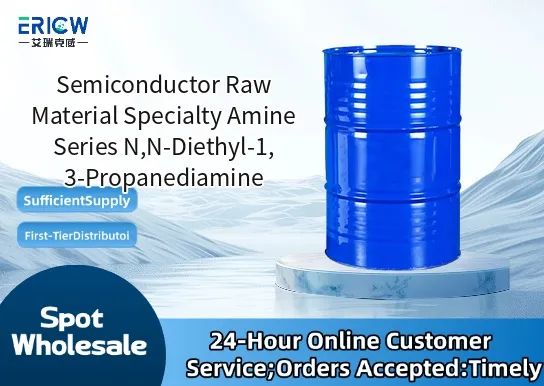
Highly selective chelating agent for transition metal ions (e.g., Cu²⁺, Ni²⁺), critical in semiconductor cleaning and CMP slurry stabilization.
Low volatility and enhanced thermal stability versus monoalkylated analogs, supporting high-temperature processing environments up to 180 °C.
Controlled basicity (pKb ≈ 3.8) enabling precise pH modulation in ultra-pure aqueous formulations without excessive ionic residue.
Ultra-low metallic impurity profile (<10 ppt each of Fe, Na, K, Ca, Al), meeting SEMI C12/C13 purity standards for front-end-of-line applications.
Hydrophilic-lipophilic balance optimized for uniform dispersion in both polar solvents (e.g., GBL, PGMEA) and dilute aqueous etchants.
Copper post-CMP cleaning formulations to prevent redox-driven re-deposition and micro-scratching.
Stabilizer in next-generation cobalt and ruthenium barrier etch chemistries for sub-3nm node interconnect integration.
Complexing ligand in photoresist developer additives to suppress metal-induced pattern collapse and line-edge roughness (LER).
Corrosion inhibitor component in low-k dielectric wet cleans targeting SiCOH and porous organosilicates.
Functional additive in electrochemical deposition (ECD) accelerators for advanced copper interconnect filling.
| Chemical Type | Tertiary diamine, aliphatic |
| Product Form | Pale yellow to colorless liquid |
| Appearance | Clear, homogeneous, free of suspended matter |
| Melting Point | −45 °C (approx.) |
| Boiling Point (760 mmHg) | 215–220 °C |
| Primary Applications | Advanced wafer cleaning, CMP slurry stabilization, metal etch inhibition |
| Key Features | Chelation selectivity, ultra-low metals, hydrolytic stability, low vapor pressure |
| Regulatory Compliance | REACH registered; RoHS 2.0 compliant; no SVHCs listed per ECHA Candidate List (v2024-01) |
| Common Compatible Systems | Suitability |
| Aqueous hydrogen peroxide (H₂O₂)/NH₄OH-based SC1 cleans | Highly Recommended – Maintains chelate integrity without oxidative degradation |
| Gamma-butyrolactone (GBL) / propylene glycol monomethyl ether acetate (PGMEA) resist solvent blends | Highly Recommended – Fully miscible; no phase separation or haze formation |
| Dilute organic acid systems (e.g., acetic/formic acid mixtures) | Recommended – Stable below pH 4.5; requires buffering for long-term storage |
| Fluorinated surfactant-containing rinse solutions | Suitable – No foaming or interfacial instability observed at ≤0.5 wt% loading |
Q1: What is the CAS Registry Number for N,N-Diethyl-1,3-propanediamine?
A: The CAS number is 104-78-9.
Q2: What is the typical recommended dosage range in copper post-CMP cleaning formulations?
A: 10–100 ppm (w/w) in final diluted chemistry; optimal performance observed at 40–60 ppm with 0.5% H₂O₂ and 500 ppm NH₃.
Q3: How does this amine compare to triethylenetetramine (TETA) in terms of metal leaching risk from stainless-steel process lines?
A: N,N-Diethyl-1,3-propanediamine exhibits significantly lower extractable metal mobilization due to steric hindrance from ethyl groups and absence of primary amines—validated by ASTM D1121 testing showing <0.05 ppb Fe release vs. 2.3 ppb for TETA under identical conditions.
Q4: Is this material certified for use in ISO Class 1 cleanroom manufacturing environments?
A: Yes—certified to ISO 14644-1 Class 1 for airborne molecular contamination (AMC) during handling; packaged under nitrogen in double-bagged, fluoropolymer-lined HDPE containers with 0.003 µm particle filtration.
Contact With Us:
E-mail: wangxingqiang@ericwchem.com
Have a Questions? Call Us:
Add:
Building A1, Jiete Industrial Park, Huangpu District, Guangzhou City, Guangdong Province, China