English
 Español
 tiếng việt
 русский
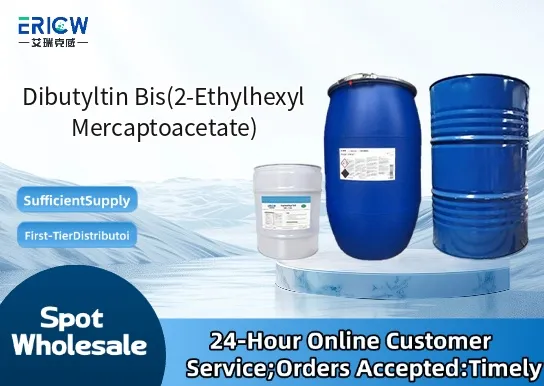
Highly effective thermal stabilizer for rigid and flexible PVC processing.
Excellent long-term color retention and low initial yellowing tendency.
Good compatibility with common PVC plasticizers including DOP, DINP, and DOTP.
Low volatility and reduced plate-out compared to monobutyltin alternatives.
Stable liquid form at room temperature—no heating or pre-melting required for dosing.
Rigid PVC profiles for window frames and siding.
PVC pipes and fittings requiring high-temperature extrusion stability.
Flexible PVC flooring and wall coverings.
Medical-grade tubing where low extractables are critical.
Automotive interior trims exposed to elevated service temperatures.
| Chemical Type | Organotin mercaptide stabilizer |
| Product Form | Clear, pale yellow to amber viscous liquid |
| Appearance | Homogeneous, free of sediment or cloudiness |
| Melting Point | Not applicable (liquid at 20 °C) |
| Primary Applications | Thermal stabilization of PVC in extrusion, calendering, and injection molding |
| Key Features | High tin content (~24–26% w/w), low odor, hydrolytic stability |
| Benefits | Reduced degradation during high-shear processing; improved melt clarity |
| Regulatory Compliance | Complies with EU REACH; not classified as SVHC under current Annex XIV |
| Common Compatible Systems | Suitability |
| Rigid PVC with Ca/Zn co-stabilizers | Highly Recommended – Synergistic performance in window profile formulations |
| Flexible PVC with phthalate-free plasticizers (e.g., TOTM, ATBC) | Recommended – Good dispersion and minimal phase separation |
| PVC/NBR blends for automotive seals | Suitable – Provides adequate heat resistance without compromising elastomeric properties |
| PVC compounded with TiO₂ pigments | Highly Recommended – Minimizes catalytic discoloration during processing |
Q1: What is the CAS Registry Number for this compound?
A: The CAS Number is 301-10-0.
Q2: What is the typical dosage range in rigid PVC applications?
A: Standard dosage is 0.5–1.5 phr (parts per hundred resin), depending on processing temperature and required stabilization duration.
Q3: How does it compare to dibutyltin dilaurate in PVC stabilization?
A: Unlike dibutyltin dilaurate—a catalyst for polyurethane foams—this mercaptide offers superior PVC-specific thermal stabilization due to its sulfur coordination, higher tin efficiency, and lower volatility.
Q4: Is migration or extraction into food simulants a concern under EU Regulation (EC) No 10/2011?
A: When used within recommended dosage and processed under controlled conditions, total tin migration remains below the specific migration limit (SML) of 0.01 mg/kg for organotins in food-contact PVC.
Contact With Us:
E-mail: wangxingqiang@ericwchem.com
Have a Questions? Call Us:
Add:
Building A1, Jiete Industrial Park, Huangpu District, Guangzhou City, Guangdong Province, China