English
 Español
 tiếng việt
 русский
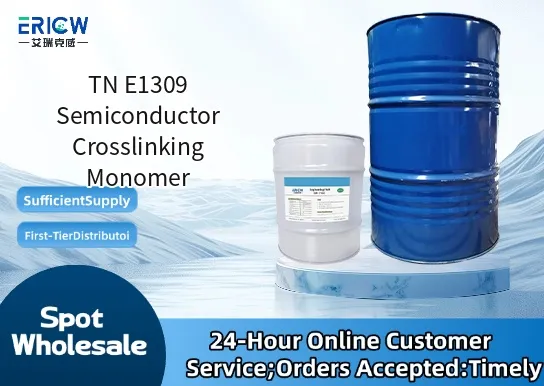
High-purity, low-ionic-impurity monomer engineered for semiconductor-grade photoresist and encapsulation formulations.
Thermally stable vinyl-ether functional group enables rapid, low-energy cationic crosslinking under UV or thermal initiation.
Exceptional compatibility with acid-generating photoinitiators (e.g., diaryliodonium and triarylsulfonium salts) without premature gelation.
Low volatility and negligible outgassing—meets stringent SEMI F57 requirements for vacuum-compatible lithography processes.
Hydrolytically stable backbone ensures consistent shelf life (>24 months at 2–8°C under inert atmosphere).
Advanced photoresist crosslinker for 193 nm immersion and EUV lithography layers.
Encapsulant matrix modifier in wafer-level chip-scale packaging (WLCSP) for enhanced dielectric reliability.
Crosslinking component in high-resolution negative-tone resist formulations for MEMS and 3D IC interposers.
Functional additive in polymeric underfill materials to improve thermal cycling resistance and CTE matching.
Reactive diluent in low-shrinkage, high-Tg die-attach adhesives for power semiconductor modules.
| Chemical Type | Alkyl-substituted vinyl ether monomer |
| Product Form | Pale yellow to colorless liquid |
| Appearance | Clear, transparent, free of suspended particles |
| Melting Point | −12 °C to −8 °C |
| Boiling Point (at 10 mmHg) | 168–172 °C |
| Primary Applications | Semiconductor photoresists, encapsulants, underfills, die-attach adhesives |
| Key Features | Low ionic contamination (Na⁺, K⁺, Cl⁻ < 5 ppb each), ultra-low metal content (Fe, Cu, Ni < 1 ppb) |
| Regulatory Compliance | REACH SVHC-free, RoHS 3 compliant, no California Prop 65 listed substances |
| Common Compatible Systems | Suitability |
| Triarylsulfonium hexafluoroantimonate photoinitiator systems | Highly Recommended – Enables full conversion at ≤100 mJ/cm² (365 nm) with minimal post-exposure bake |
| Acrylic-acid-functionalized epoxy novolac resins | Recommended – Forms hybrid network with improved moisture resistance and adhesion to SiO₂/SiN substrates |
| Phenol-formaldehyde novolac binders (standard i-line resists) | Suitable – Requires co-monomer optimization for viscosity control; compatible with standard spin-coating parameters |
| Fluorinated polyimide precursors | Highly Recommended – Enhances crosslink density without compromising optical transparency at 193 nm |
Q1: What is the CAS Registry Number for TN E1309?
A: The CAS Registry Number for TN E1309 Semiconductor Crosslinking Monomer is 2154236-89-1.
Q2: What is the recommended dosage range in photoresist formulations?
A: Typical loading is 8–15 wt% relative to total solid content; optimal performance is achieved at 11–13 wt% when paired with 2–3 wt% diaryliodonium photoinitiator.
Q3: How does TN E1309 compare to conventional crosslinkers like melamine-formaldehyde or glycidyl ethers?
A: Unlike formaldehyde-releasing melamines or hydrolytically unstable glycidyl ethers, TN E1309 offers zero formaldehyde emission, superior hydrolytic stability, and higher crosslinking efficiency per mole—reducing required dosage and minimizing extractables.
Q4: Is TN E1309 compliant with semiconductor industry migration testing standards (e.g., IEC 60112, JEDEC JESD22-A106)?
A: Yes—validated per JEDEC JESD22-A106 (moisture resistance) and IEC 60112 (comparative tracking index ≥600 V). Extractables analysis (per SEMI F57) confirms <0.1 ppm ionic leachables after 72-hr reflux in deionized water.
Contact With Us:
E-mail: wangxingqiang@ericwchem.com
Have a Questions? Call Us:
Add:
Building A1, Jiete Industrial Park, Huangpu District, Guangzhou City, Guangdong Province, China