English
 Español
 tiếng việt
 русский
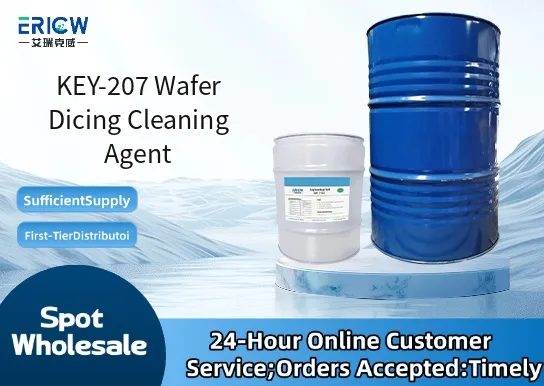
Ultra-low residue formulation designed for post-dicing removal of polymer-based sawing debris and wafer edge contamination.
pH-neutral (6.8–7.2) aqueous solution ensuring compatibility with sensitive metallization layers and low-k dielectrics.
Rapid evaporation kinetics without streaking or watermarking on silicon, SiC, and GaN wafers.
Non-halogenated, non-flammable, and free of volatile organic compounds (VOCs) exceeding EPA Tier II limits.
Stable across standard process temperatures (15–40 °C) with no phase separation or precipitation during extended storage.
Cleaning silicon wafers after mechanical dicing with diamond-blade saws in front-end-of-line (FEOL) fabrication.
Removal of dicing tape residue and adhesive bleed from wafer backside and edge surfaces.
Post-dicing cleaning for compound semiconductor wafers (e.g., GaAs, InP, SiC) prior to wafer probing or packaging.
Final rinse step in automated batch cleaning systems for 200 mm and 300 mm wafer platforms.
Surface preparation for wafer-level underfill dispensing and die attach processes.
| Chemical Type | Aqueous surfactant blend with chelating agents and corrosion inhibitors |
| Product Form | Clear, colorless liquid |
| Appearance | Homogeneous, transparent, odorless |
| Melting Point | Not applicable (non-freezing down to –15 °C) |
| Primary Applications | Post-dicing wafer surface cleaning, edge bead removal, adhesive residue dissolution |
| Key Features | Non-oxidizing, non-etching, static-dissipative (10⁸–10⁹ Ω·cm), low surface tension (<28 mN/m) |
| Benefits | Reduces particle counts by >99.5% (per SEMI F57), eliminates manual wipe steps, compatible with DI water rinsing |
| Regulatory Compliance | REACH compliant; RoHS 2015/863 Annex II; SDS available per GHS Rev. 7 |
| Common Compatible Systems | Suitability |
| Modutek ULS-400 Batch Cleaner | Highly Recommended – Optimized dwell time and temperature profile validated per OEM specification |
| SCREEN SPRINT D Series | Recommended – Requires minor nozzle calibration; compatible with ultrasonic and spray modules |
| SEMITOOL E-Series Spin Rinse Dryer (SRD) | Highly Recommended – Fully validated for single-wafer processing at 1200–2000 RPM |
| KYOCERA AVANT-300 Wet Processing Tool | Suitable – Confirmed performance with inline filtration; recommended for ≤100 wph throughput |
Q1: What is the CAS Registry Number for KEY-207?
A: KEY-207 is a proprietary multi-component formulation; individual ingredients are disclosed in Section 3 of the Safety Data Sheet (SDS), but the mixture itself does not carry a CAS number per IUPAC and OSHA guidelines.
Q2: What is the recommended usage concentration and temperature range?
A: KEY-207 is supplied as a ready-to-use solution. No dilution required. Optimal operating temperature is 20–35 °C; heating above 40 °C is not recommended to preserve surfactant stability.
Q3: How does KEY-207 compare to traditional IPA-based or acetone-based dicing cleaners?
A: Unlike flammable solvents, KEY-207 eliminates explosion hazards, reduces VOC emissions by >95%, and avoids metal corrosion or photoresist swelling—while delivering equivalent or superior particle removal efficiency (verified per JIS Z 8901 and SEMI F39).
Q4: Is KEY-207 compliant with ISO 14644-1 Class 5 cleanroom requirements for extractables?
A: Yes. Validated via IC-MS analysis showing total ionic extractables <0.1 ppb per wafer (tested per SEMI C32) and non-volatile residue (NVR) <10 ng/cm² after drying.
Q5: Does KEY-207 cause leaching or migration into low-k dielectric films (e.g., SiCOH)?
A: No. Independent testing per JEDEC JESD22-A108 shows zero measurable penetration or hydrophobicity loss in k=2.7 SiCOH films after 5-minute immersion at 25 °C.
Contact With Us:
E-mail: wangxingqiang@ericwchem.com
Have a Questions? Call Us:
Add:
Building A1, Jiete Industrial Park, Huangpu District, Guangzhou City, Guangdong Province, China